Portfolio-Level XVA Risk Computation with Pargraph#
A bank’s XVA desk computes Credit Valuation Adjustment (CVA) and Funding Valuation Adjustment (FVA) across a multi-asset portfolio spanning interest rates, FX, equities, and credit. The CVA for a netting set is:
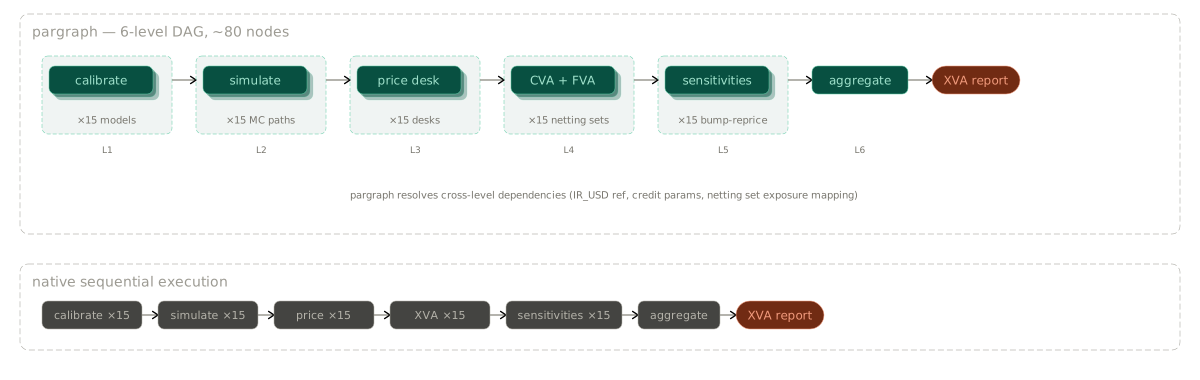
The pipeline forms a 6-level DAG with ~80 compute nodes:
Level 1 — Calibrate stochastic models for 15 asset sub-classes (IR×5, FX×4, EQ×3, Credit×3)
Level 2 — Monte Carlo path simulation for each calibrated model (15 parallel)
Level 3 — Portfolio pricing per desk/asset class (15 parallel)
Level 4 — XVA (CVA+FVA) per netting set / counterparty (15 parallel)
Level 5 — Sensitivity/Greeks per netting set via bump-and-reprice (15 parallel)
Level 6 — Aggregate final XVA risk report (1 node)
Pargraph schedules the pipeline as a DAG: at each level, all 15 independent nodes execute in parallel across Scaler workers. The critical path is only 6 levels deep regardless of the number of models, desks, or netting sets.
Program Structure#
Native Python Implementation#
[ ]:
import os

os.environ["OPENBLAS_NUM_THREADS"] = "1"
os.environ["GOTO_NUM_THREADS"] = "1"
os.environ["OMP_NUM_THREADS"] = "1"
os.environ["MKL_NUM_THREADS"] = "1"

from dataclasses import dataclass, field
from typing import Dict, List, Tuple

import numpy as np

# ---------------------------------------------------------------------------
# Data classes — small, serializable results passed between DAG nodes
# ---------------------------------------------------------------------------


@dataclass
class ModelParams:
    """Calibrated model parameters. Tiny payload (few floats)."""

    name: str
    mean_reversion: float
    volatility: float
    long_term_mean: float
    correlation_to_rates: float
    calibration_error: float


@dataclass
class SimulationResult:
    """Summary statistics from Monte Carlo simulation. Small payload."""

    asset_class: str
    n_paths: int
    n_timesteps: int
    mean_path: np.ndarray  # shape (n_timesteps,)
    percentile_97_5: np.ndarray
    percentile_2_5: np.ndarray
    terminal_distribution_moments: Tuple[float, float, float, float]


@dataclass
class ExposureProfile:
    """Portfolio exposure profile for one desk/asset class. Small payload."""

    asset_class: str
    n_trades: int
    expected_exposure: np.ndarray  # shape (n_timesteps,)
    expected_positive_exposure: np.ndarray
    expected_negative_exposure: np.ndarray
    peak_exposure: float


@dataclass
class XVAResult:
    """XVA metrics for a single netting set."""

    netting_set: str
    cva: float
    fva: float
    term_structure_cva: np.ndarray
    term_structure_fva: np.ndarray


@dataclass
class SensitivityResult:
    """Greeks/sensitivities for one netting set."""

    netting_set: str
    delta_ir: float
    delta_credit: float
    delta_fx: float
    delta_equity: float
    gamma_ir: float
    vega: float


@dataclass
class XVARiskReport:
    """Final aggregated report. Small payload."""

    total_cva: float
    total_fva: float
    total_xva: float
    netting_set_breakdown: Dict[str, Dict[str, float]]
    cva_sensitivities: Dict[str, float]
    fva_sensitivities: Dict[str, float]


# ---------------------------------------------------------------------------
# Configuration
# ---------------------------------------------------------------------------


@dataclass
class ComputeConfig:
    """Controls how heavy each computation step is."""

    n_paths: int
    n_timesteps: int
    n_trades: int  # trades per desk
    n_calibration_iterations: int
    bump_size: float = 0.0001


TEST_CONFIG = ComputeConfig(
    n_paths=10_000,
    n_timesteps=60,
    n_trades=100,
    n_calibration_iterations=5_000,
)

MEDIUM_CONFIG = ComputeConfig(
    n_paths=100_000,
    n_timesteps=180,
    n_trades=300,
    n_calibration_iterations=15_000,
)

FULL_CONFIG = ComputeConfig(
    n_paths=500_000,
    n_timesteps=360,
    n_trades=2_000,
    n_calibration_iterations=50_000,
)


# ---------------------------------------------------------------------------
# Asset class definitions — 15 models to calibrate
# ---------------------------------------------------------------------------

# (name, seed, param_ranges, correlation_to_rates)
MODELS = [
    # 5 IR curves (different currencies)
    ("IR_USD", 100, {"mr": (0.01, 0.5), "vol": (0.005, 0.02), "mean": (0.02, 0.05)}, 1.0),
    ("IR_EUR", 101, {"mr": (0.01, 0.5), "vol": (0.003, 0.015), "mean": (0.01, 0.04)}, 0.9),
    ("IR_GBP", 102, {"mr": (0.01, 0.5), "vol": (0.004, 0.018), "mean": (0.015, 0.045)}, 0.85),
    ("IR_JPY", 103, {"mr": (0.01, 0.5), "vol": (0.001, 0.008), "mean": (-0.005, 0.015)}, 0.7),
    ("IR_CHF", 104, {"mr": (0.01, 0.5), "vol": (0.002, 0.012), "mean": (-0.003, 0.02)}, 0.75),
    # 4 FX pairs
    ("FX_EURUSD", 200, {"mr": (0.0, 0.3), "vol": (0.05, 0.15), "mean": (1.0, 1.2)}, 0.3),
    ("FX_GBPUSD", 201, {"mr": (0.0, 0.3), "vol": (0.06, 0.18), "mean": (1.2, 1.4)}, 0.25),
    ("FX_USDJPY", 202, {"mr": (0.0, 0.3), "vol": (0.04, 0.12), "mean": (100, 150)}, 0.2),
    ("FX_USDCHF", 203, {"mr": (0.0, 0.3), "vol": (0.05, 0.14), "mean": (0.85, 1.0)}, 0.22),
    # 3 equity indices
    ("EQ_SPX", 300, {"mr": (0.5, 5.0), "vol": (0.1, 0.5), "mean": (0.02, 0.08)}, -0.2),
    ("EQ_EUROSTOXX", 301, {"mr": (0.5, 5.0), "vol": (0.12, 0.6), "mean": (0.02, 0.10)}, -0.25),
    ("EQ_NIKKEI", 302, {"mr": (0.5, 5.0), "vol": (0.10, 0.45), "mean": (0.01, 0.07)}, -0.15),
    # 3 credit sectors
    ("CR_IG", 400, {"mr": (0.01, 1.0), "vol": (0.005, 0.03), "mean": (0.003, 0.015)}, -0.15),
    ("CR_HY", 401, {"mr": (0.01, 1.0), "vol": (0.01, 0.06), "mean": (0.01, 0.05)}, -0.25),
    ("CR_EM", 402, {"mr": (0.01, 1.0), "vol": (0.008, 0.05), "mean": (0.008, 0.04)}, -0.20),
]

# 15 desks for pricing (one per model)
DESK_NAMES = [m[0] for m in MODELS]

# 15 netting sets for XVA
NETTING_SETS = [
    "NS_USBank1", "NS_USBank2", "NS_USBank3",
    "NS_EUBank1", "NS_EUBank2", "NS_EUBank3",
    "NS_UKBank1", "NS_UKBank2",
    "NS_JPBank1", "NS_JPBank2",
    "NS_Hedge1", "NS_Hedge2", "NS_Hedge3",
    "NS_Corp1", "NS_Corp2",
]

# Map netting sets to credit sector and subset of desks they trade with
NETTING_SET_CONFIG = {}
for i, ns in enumerate(NETTING_SETS):
    # Each netting set references a credit model and a subset of desks
    credit_model = ["CR_IG", "CR_HY", "CR_EM"][i % 3]
    # Each netting set sees 5 of the 15 desks (rotating)
    desk_indices = [(i * 3 + j) % 15 for j in range(5)]
    NETTING_SET_CONFIG[ns] = {
        "credit_model": credit_model,
        "desk_indices": desk_indices,
        "seed": 7000 + i,
    }


# ---------------------------------------------------------------------------
# Level 1: Model Calibration (15 parallel nodes)
# ---------------------------------------------------------------------------


def _calibrate_model(name: str, seed: int, param_ranges: dict,
                     corr: float, config: ComputeConfig) -> ModelParams:
    """Generic calibration: iterative least-squares fitting.

    Heavy compute: n_calibration_iterations × (n_paths/10 × n_market_instruments).
    Output: ~6 floats.
    """
    rng = np.random.default_rng(seed)
    n_instruments = 60 + seed % 40  # 60-100 instruments

    market_data = 0.01 + 0.005 * rng.standard_normal(n_instruments)

    best_params = None
    best_error = float("inf")

    for _ in range(config.n_calibration_iterations):
        trial_mr = rng.uniform(*param_ranges["mr"])
        trial_vol = rng.uniform(*param_ranges["vol"])
        trial_mean = rng.uniform(*param_ranges["mean"])

        dt = 1.0 / 12
        paths = rng.standard_normal((config.n_paths // 10, n_instruments))
        model_vols = trial_vol * np.sqrt(
            (1 - np.exp(-2 * trial_mr * dt)) / (2 * max(trial_mr, 1e-6))
        )
        model_prices = trial_mean + model_vols * paths
        implied_vols = np.std(model_prices, axis=0)

        error = np.mean((implied_vols - np.abs(market_data)) ** 2)
        if error < best_error:
            best_error = error
            best_params = (trial_mr, trial_vol, trial_mean)

    return ModelParams(
        name=name,
        mean_reversion=best_params[0],
        volatility=best_params[1],
        long_term_mean=best_params[2],
        correlation_to_rates=corr,
        calibration_error=best_error,
    )


# Generate one calibration function per model (15 functions).
# Each is a standalone callable that pargraph can dispatch independently.

def _make_calibrator(name, seed, ranges, corr):
    """Factory: return a function(config) -> ModelParams for one model."""
    def calibrate(config: ComputeConfig) -> ModelParams:
        return _calibrate_model(name, seed, ranges, corr, config)
    calibrate.__name__ = f"calibrate_{name.lower()}"
    calibrate.__qualname__ = calibrate.__name__
    return calibrate


CALIBRATORS = {}
for _name, _seed, _ranges, _corr in MODELS:
    CALIBRATORS[_name] = _make_calibrator(_name, _seed, _ranges, _corr)


# ---------------------------------------------------------------------------
# Level 2: Monte Carlo Simulation (15 parallel nodes)
# ---------------------------------------------------------------------------


def _simulate_paths(params: ModelParams, ir_ref_params: ModelParams,
                    config: ComputeConfig, seed: int) -> SimulationResult:
    """Generic path simulation using calibrated parameters.

    Heavy compute: n_paths × n_timesteps evolution with chunked memory.
    Output: 3 vectors of length n_timesteps + 4 floats.
    """
    from scipy.stats import kurtosis, skew

    rng = np.random.default_rng(seed)
    dt = 1.0 / 12
    n = config.n_timesteps
    kappa = params.mean_reversion
    sigma = params.volatility
    theta = params.long_term_mean
    rho = params.correlation_to_rates

    chunk_size = min(config.n_paths, 10_000)
    n_chunks = max(config.n_paths // chunk_size, 1)

    running_sum = np.zeros(n)
    running_sum_sq = np.zeros(n)
    terminal_values = []

    is_equity = params.name.startswith("EQ_")
    is_fx = params.name.startswith("FX_")

    for _ in range(n_chunks):
        if is_equity:
            # Heston-style stochastic vol
            log_s = np.zeros((chunk_size, n))
            variance = np.full(chunk_size, theta)
            xi = sigma  # vol of vol
            v_bar = theta
            for t in range(1, n):
                z1 = rng.standard_normal(chunk_size)
                z2 = rng.standard_normal(chunk_size)
                z_vol = -0.7 * z1 + np.sqrt(1 - 0.49) * z2
                variance = np.maximum(
                    variance + kappa * (v_bar - variance) * dt
                    + xi * np.sqrt(np.maximum(variance, 0) * dt) * z_vol,
                    1e-8,
                )
                r = ir_ref_params.long_term_mean
                log_s[:, t] = (log_s[:, t - 1]
                               + (r - 0.5 * variance) * dt
                               + np.sqrt(variance * dt) * z1)
            values = np.exp(log_s) * 100
        elif is_fx:
            # GBM with stochastic drift from IR differential
            log_fx = np.zeros((chunk_size, n))
            log_fx[:, 0] = np.log(max(theta, 0.01))
            for t in range(1, n):
                z1 = rng.standard_normal(chunk_size)
                z2 = rng.standard_normal(chunk_size)
                z_corr = rho * z1 + np.sqrt(max(1 - rho**2, 0)) * z2
                ir_diff = ir_ref_params.long_term_mean * 0.1 * np.sin(2 * np.pi * t / 12)
                log_fx[:, t] = (log_fx[:, t - 1]
                                + (ir_diff - 0.5 * sigma**2) * dt
                                + sigma * np.sqrt(dt) * z_corr)
            values = np.exp(log_fx)
        else:
            # Mean-reverting (IR or Credit)
            rates = np.zeros((chunk_size, n))
            rates[:, 0] = theta
            for t in range(1, n):
                dW = rng.standard_normal(chunk_size) * np.sqrt(dt)
                rates[:, t] = (rates[:, t - 1]
                               + kappa * (theta - rates[:, t - 1]) * dt
                               + sigma * dW)
            values = rates

        running_sum += np.sum(values, axis=0)
        running_sum_sq += np.sum(values**2, axis=0)
        terminal_values.extend(values[:, -1].tolist())

    total = chunk_size * n_chunks
    mean_path = running_sum / total
    std_path = np.sqrt(np.maximum(running_sum_sq / total - mean_path**2, 0))

    terminal = np.array(terminal_values)
    return SimulationResult(
        asset_class=params.name,
        n_paths=config.n_paths,
        n_timesteps=n,
        mean_path=mean_path,
        percentile_97_5=mean_path + 1.96 * std_path,
        percentile_2_5=mean_path - 1.96 * std_path,
        terminal_distribution_moments=(
            float(np.mean(terminal)),
            float(np.std(terminal)),
            float(skew(terminal)),
            float(kurtosis(terminal)),
        ),
    )


def _make_simulator(model_name: str, seed: int, needs_ir_ref: bool):
    """Factory: return a simulation function for one model.

    IR_USD is the reference curve; other models may depend on it.
    """
    if model_name == "IR_USD":
        # IR_USD doesn't depend on another IR ref
        def simulate(params: ModelParams, config: ComputeConfig) -> SimulationResult:
            return _simulate_paths(params, params, config, seed)
    elif needs_ir_ref:
        def simulate(params: ModelParams, ir_usd_params: ModelParams,
                     config: ComputeConfig) -> SimulationResult:
            return _simulate_paths(params, ir_usd_params, config, seed)
    else:
        # Credit models don't need IR ref for simulation
        def simulate(params: ModelParams, config: ComputeConfig) -> SimulationResult:
            return _simulate_paths(params, ModelParams("dummy", 0.1, 0.01, 0.03, 0, 0),
                                   config, seed)
    simulate.__name__ = f"simulate_{model_name.lower()}"
    simulate.__qualname__ = simulate.__name__
    return simulate


SIMULATORS = {}
for _name, _seed, _, _ in MODELS:
    _needs_ir = _name.startswith("FX_") or _name.startswith("EQ_") or (
        _name.startswith("IR_") and _name != "IR_USD"
    )
    SIMULATORS[_name] = _make_simulator(_name, 1000 + _seed, _needs_ir)


# ---------------------------------------------------------------------------
# Level 3: Portfolio Pricing (15 parallel nodes, one per desk)
# ---------------------------------------------------------------------------


def _price_desk_portfolio(sim: SimulationResult, ir_ref_sim: SimulationResult,
                          config: ComputeConfig, seed: int) -> ExposureProfile:
    """Price a desk's portfolio under simulated scenarios.

    Heavy compute: n_trades × n_scenarios present value calculations per timestep.
    """
    rng = np.random.default_rng(seed)
    n = sim.n_timesteps

    notionals = rng.uniform(1e6, 50e6, config.n_trades)
    strikes = sim.mean_path[0] * rng.uniform(0.9, 1.1, config.n_trades)
    maturities = rng.integers(max(12, n // 4), n, config.n_trades)
    is_option = rng.random(config.n_trades) > 0.5

    ee = np.zeros(n)
    epe = np.zeros(n)
    ene = np.zeros(n)

    for t in range(n):
        alive = maturities > t
        if not np.any(alive):
            continue
        remaining = (maturities[alive] - t) / 12.0
        spot = sim.mean_path[t]
        spread = max((sim.percentile_97_5[t] - sim.percentile_2_5[t]) / 2, 1e-10)
        r = ir_ref_sim.mean_path[min(t, len(ir_ref_sim.mean_path) - 1)]

        n_scenarios = max(config.n_paths // 100, 10)
        scenario_mtms = np.zeros(n_scenarios)

        for s in range(n_scenarios):
            scenario_factor = spot + rng.standard_normal() * spread
            mtm = notionals[alive] * remaining * (scenario_factor - strikes[alive])
            opt_mask = is_option[alive]
            mtm[opt_mask] = np.maximum(mtm[opt_mask], 0)
            scenario_mtms[s] = np.sum(mtm * np.exp(-max(r, 0) * remaining))

        ee[t] = np.mean(scenario_mtms)
        epe[t] = np.mean(np.maximum(scenario_mtms, 0))
        ene[t] = np.mean(np.minimum(scenario_mtms, 0))

    return ExposureProfile(
        asset_class=sim.asset_class,
        n_trades=config.n_trades,
        expected_exposure=ee,
        expected_positive_exposure=epe,
        expected_negative_exposure=ene,
        peak_exposure=float(np.max(np.abs(epe))),
    )


def _make_pricer(model_name: str, seed: int):
    """Factory: return a pricing function for one desk."""
    if model_name == "IR_USD":
        def price(sim: SimulationResult, config: ComputeConfig) -> ExposureProfile:
            return _price_desk_portfolio(sim, sim, config, seed)
    else:
        def price(sim: SimulationResult, ir_usd_sim: SimulationResult,
                  config: ComputeConfig) -> ExposureProfile:
            return _price_desk_portfolio(sim, ir_usd_sim, config, seed)
    price.__name__ = f"price_{model_name.lower()}"
    price.__qualname__ = price.__name__
    return price


PRICERS = {}
for _name, _seed, _, _ in MODELS:
    PRICERS[_name] = _make_pricer(_name, 4000 + _seed)


# ---------------------------------------------------------------------------
# Level 4: XVA per Netting Set (15 parallel nodes)
# ---------------------------------------------------------------------------


def _compute_netting_set_xva(
    exposure_profiles: List[ExposureProfile],
    credit_params: ModelParams,
    config: ComputeConfig,
    seed: int,
    ns_name: str,
) -> XVAResult:
    """Compute CVA + FVA for a single netting set.

    Aggregates exposure from the desks this counterparty trades with,
    then runs Monte Carlo on credit intensity and funding cost.
    """
    rng = np.random.default_rng(seed)
    n = len(exposure_profiles[0].expected_positive_exposure)
    dt = 1.0 / 12
    lgd = 0.6
    funding_spread = 0.005

    # Aggregate EPE/EE across desks in this netting set
    total_epe = np.zeros(n)
    total_ee = np.zeros(n)
    for ep in exposure_profiles:
        total_epe += ep.expected_positive_exposure
        total_ee += ep.expected_exposure

    intensity = credit_params.long_term_mean
    vol = credit_params.volatility
    kappa = credit_params.mean_reversion

    n_mc = config.n_paths
    chunk_size = min(n_mc, 10_000)
    n_chunks = max(n_mc // chunk_size, 1)

    cva_samples = np.zeros(n_chunks)
    fva_samples = np.zeros(n_chunks)
    cva_ts = np.zeros(n)
    fva_ts = np.zeros(n)

    for c in range(n_chunks):
        lam = np.full(chunk_size, max(intensity, 1e-6))
        spread = np.full(chunk_size, funding_spread)
        survival = np.ones(chunk_size)
        chunk_cva = np.zeros(chunk_size)
        chunk_fva = np.zeros(chunk_size)

        for t in range(n):
            dW = rng.standard_normal(chunk_size) * np.sqrt(dt)
            dW2 = rng.standard_normal(chunk_size) * np.sqrt(dt)

            lam = np.maximum(
                lam + kappa * (intensity - lam) * dt
                + vol * np.sqrt(np.maximum(lam, 0)) * dW,
                1e-6,
            )
            spread = np.maximum(
                spread + 0.1 * (funding_spread - spread) * dt + 0.001 * dW2,
                0,
            )

            default_prob = 1 - np.exp(-lam * dt)
            discount = np.exp(-0.03 * t * dt)

            inc_cva = discount * lgd * total_epe[t] * default_prob * survival
            inc_fva = discount * spread * total_ee[t] * dt

            chunk_cva += inc_cva
            chunk_fva += inc_fva
            cva_ts[t] += np.sum(inc_cva)
            fva_ts[t] += np.sum(inc_fva)

            survival *= 1 - default_prob

        cva_samples[c] = np.mean(chunk_cva)
        fva_samples[c] = np.mean(chunk_fva)

    denom = n_chunks * chunk_size
    cva_ts /= denom
    fva_ts /= denom

    return XVAResult(
        netting_set=ns_name,
        cva=float(np.mean(cva_samples)),
        fva=float(np.mean(fva_samples)),
        term_structure_cva=cva_ts,
        term_structure_fva=fva_ts,
    )


def _make_xva_calculator(ns_name: str, ns_cfg: dict, n_desks: int):
    """Factory: return a function that computes XVA for one netting set.

    The function signature lists the exact exposure profiles + credit params
    it needs so pargraph can wire the DAG edges.
    """
    desk_indices = ns_cfg["desk_indices"]
    seed = ns_cfg["seed"]

    # Build a function that takes (exp_0, exp_1, ..., exp_4, credit_params, config)
    def compute_xva(*args) -> XVAResult:
        # Last two args are credit_params and config
        config = args[-1]
        credit_params = args[-2]
        exposures = list(args[:-2])
        return _compute_netting_set_xva(exposures, credit_params, config, seed, ns_name)

    compute_xva.__name__ = f"xva_{ns_name.lower()}"
    compute_xva.__qualname__ = compute_xva.__name__
    return compute_xva


XVA_CALCULATORS = {}
for _ns, _cfg in NETTING_SET_CONFIG.items():
    XVA_CALCULATORS[_ns] = _make_xva_calculator(_ns, _cfg, len(DESK_NAMES))


# ---------------------------------------------------------------------------
# Level 5: Sensitivities per Netting Set (15 parallel nodes)
# ---------------------------------------------------------------------------


def _compute_netting_set_sensitivities(
    xva: XVAResult,
    exposure_profiles: List[ExposureProfile],
    credit_params: ModelParams,
    config: ComputeConfig,
    seed: int,
    ns_name: str,
) -> SensitivityResult:
    """Bump-and-reprice sensitivities for one netting set.

    Re-runs XVA with bumped inputs for IR, credit, FX, equity.
    """
    bump = config.bump_size
    base_cva = xva.cva

    def _bumped_exposures(factor):
        return [
            ExposureProfile(
                asset_class=ep.asset_class,
                n_trades=ep.n_trades,
                expected_exposure=ep.expected_exposure * factor,
                expected_positive_exposure=ep.expected_positive_exposure * factor,
                expected_negative_exposure=ep.expected_negative_exposure * factor,
                peak_exposure=ep.peak_exposure * factor,
            )
            for ep in exposure_profiles
        ]

    # Delta IR: bump all exposures
    xva_up = _compute_netting_set_xva(
        _bumped_exposures(1 + bump * 1000), credit_params, config, seed + 100, ns_name
    )
    delta_ir = (xva_up.cva - base_cva) / bump

    # Delta Credit: bump intensity
    cr_bumped = ModelParams(
        name=credit_params.name,
        mean_reversion=credit_params.mean_reversion,
        volatility=credit_params.volatility,
        long_term_mean=credit_params.long_term_mean * (1 + bump * 100),
        correlation_to_rates=credit_params.correlation_to_rates,
        calibration_error=credit_params.calibration_error,
    )
    xva_cr = _compute_netting_set_xva(
        exposure_profiles, cr_bumped, config, seed + 200, ns_name
    )
    delta_credit = (xva_cr.cva - base_cva) / bump

    # Delta FX
    xva_fx = _compute_netting_set_xva(
        _bumped_exposures(1 + bump * 100), credit_params, config, seed + 300, ns_name
    )
    delta_fx = (xva_fx.cva - base_cva) / bump

    # Delta Equity
    xva_eq = _compute_netting_set_xva(
        _bumped_exposures(1 + bump * 50), credit_params, config, seed + 400, ns_name
    )
    delta_eq = (xva_eq.cva - base_cva) / bump

    # Gamma IR
    xva_down = _compute_netting_set_xva(
        _bumped_exposures(1 - bump * 1000), credit_params, config, seed + 500, ns_name
    )
    gamma_ir = (xva_up.cva - 2 * base_cva + xva_down.cva) / (bump**2)

    # Vega
    cr_vega = ModelParams(
        name=credit_params.name,
        mean_reversion=credit_params.mean_reversion,
        volatility=credit_params.volatility * (1 + bump * 100),
        long_term_mean=credit_params.long_term_mean,
        correlation_to_rates=credit_params.correlation_to_rates,
        calibration_error=credit_params.calibration_error,
    )
    xva_vega = _compute_netting_set_xva(
        exposure_profiles, cr_vega, config, seed + 600, ns_name
    )
    vega = (xva_vega.cva - base_cva) / bump

    return SensitivityResult(
        netting_set=ns_name,
        delta_ir=delta_ir,
        delta_credit=delta_credit,
        delta_fx=delta_fx,
        delta_equity=delta_eq,
        gamma_ir=gamma_ir,
        vega=vega,
    )


def _make_sensitivity_calculator(ns_name: str, ns_cfg: dict):
    """Factory: return a function that computes sensitivities for one netting set."""
    desk_indices = ns_cfg["desk_indices"]
    seed = ns_cfg["seed"]

    def compute_sens(*args) -> SensitivityResult:
        # args: xva_result, exp_0..exp_4, credit_params, config
        config = args[-1]
        credit_params = args[-2]
        xva = args[0]
        exposures = list(args[1:-2])
        return _compute_netting_set_sensitivities(
            xva, exposures, credit_params, config, seed, ns_name
        )

    compute_sens.__name__ = f"sens_{ns_name.lower()}"
    compute_sens.__qualname__ = compute_sens.__name__
    return compute_sens


SENSITIVITY_CALCULATORS = {}
for _ns, _cfg in NETTING_SET_CONFIG.items():
    SENSITIVITY_CALCULATORS[_ns] = _make_sensitivity_calculator(_ns, _cfg)


# ---------------------------------------------------------------------------
# Level 6: Report Aggregation
# ---------------------------------------------------------------------------


def aggregate_xva_report(*args) -> XVARiskReport:
    """Aggregate all netting set XVA results + sensitivities into final report.

    args: xva_1, ..., xva_15, sens_1, ..., sens_15
    """
    n_ns = len(NETTING_SETS)
    xva_results = args[:n_ns]
    sens_results = args[n_ns:2 * n_ns]

    total_cva = sum(x.cva for x in xva_results)
    total_fva = sum(x.fva for x in xva_results)

    breakdown = {}
    for xva in xva_results:
        breakdown[xva.netting_set] = {"cva": xva.cva, "fva": xva.fva}

    # Aggregate sensitivities
    agg_cva_sens = {"delta_ir": 0, "delta_credit": 0, "delta_fx": 0,
                    "delta_equity": 0, "gamma_ir": 0, "vega": 0}
    agg_fva_sens = dict(agg_cva_sens)
    for s in sens_results:
        agg_cva_sens["delta_ir"] += s.delta_ir
        agg_cva_sens["delta_credit"] += s.delta_credit
        agg_cva_sens["delta_fx"] += s.delta_fx
        agg_cva_sens["delta_equity"] += s.delta_equity
        agg_cva_sens["gamma_ir"] += s.gamma_ir
        agg_cva_sens["vega"] += s.vega

    return XVARiskReport(
        total_cva=total_cva,
        total_fva=total_fva,
        total_xva=total_cva + total_fva,
        netting_set_breakdown=breakdown,
        cva_sensitivities=agg_cva_sens,
        fva_sensitivities=agg_fva_sens,
    )

# ---------------------------------------------------------------------------
# Pretty printing
# ---------------------------------------------------------------------------


def print_report(report: XVARiskReport) -> None:
    print("\n" + "=" * 60)
    print("           XVA RISK REPORT")
    print("=" * 60)
    print(f"  CVA:       {report.total_cva:>16,.2f}")
    print(f"  FVA:       {report.total_fva:>16,.2f}")
    print(f"  Total XVA: {report.total_xva:>16,.2f}")
    print("-" * 60)
    print("  Netting Set Breakdown:")
    for ns, vals in report.netting_set_breakdown.items():
        print(f"    {ns:>15s}: CVA={vals['cva']:>12,.2f}  FVA={vals['fva']:>12,.2f}")
    print("-" * 60)
    print("  CVA Sensitivities:")
    for k, v in report.cva_sensitivities.items():
        print(f"    {k:>15s}: {v:>16,.2f}")
    print("  FVA Sensitivities:")
    for k, v in report.fva_sensitivities.items():
        print(f"    {k:>15s}: {v:>16,.2f}")
    print("-" * 60)
    print("=" * 60)


def run_sequential(config: ComputeConfig) -> XVARiskReport:
    """Run the full pipeline sequentially."""
    params = {}
    for name in DESK_NAMES:
        params[name] = CALIBRATORS[name](config)

    sims = {}
    for name in DESK_NAMES:
        if name == "IR_USD":
            sims[name] = SIMULATORS[name](params[name], config)
        elif name.startswith("CR_"):
            sims[name] = SIMULATORS[name](params[name], config)
        else:
            sims[name] = SIMULATORS[name](params[name], params["IR_USD"], config)

    exposures = {}
    for name in DESK_NAMES:
        if name == "IR_USD":
            exposures[name] = PRICERS[name](sims[name], config)
        else:
            exposures[name] = PRICERS[name](sims[name], sims["IR_USD"], config)

    xva_results = {}
    for ns_name, ns_cfg in NETTING_SET_CONFIG.items():
        desk_exps = [exposures[DESK_NAMES[i]] for i in ns_cfg["desk_indices"]]
        credit_p = params[ns_cfg["credit_model"]]
        xva_results[ns_name] = _compute_netting_set_xva(
            desk_exps, credit_p, config, ns_cfg["seed"], ns_name
        )

    sens_results = {}
    for ns_name, ns_cfg in NETTING_SET_CONFIG.items():
        desk_exps = [exposures[DESK_NAMES[i]] for i in ns_cfg["desk_indices"]]
        credit_p = params[ns_cfg["credit_model"]]
        sens_results[ns_name] = _compute_netting_set_sensitivities(
            xva_results[ns_name], desk_exps, credit_p, config, ns_cfg["seed"], ns_name
        )

    report_args = (
        [xva_results[ns] for ns in NETTING_SETS]
        + [sens_results[ns] for ns in NETTING_SETS]
    )
    report = aggregate_xva_report(*report_args)
    print_report(report)
    return report

run_sequential(MEDIUM_CONFIG)
Pargraph Implementation#
[ ]:
import os

os.environ["OPENBLAS_NUM_THREADS"] = "1"
os.environ["GOTO_NUM_THREADS"] = "1"
os.environ["OMP_NUM_THREADS"] = "1"
os.environ["MKL_NUM_THREADS"] = "1"

from dataclasses import dataclass, field
from typing import Dict, List, Tuple

import numpy as np
from pargraph import GraphEngine
from scaler import Client, SchedulerClusterCombo

# ---------------------------------------------------------------------------
# Data classes — small, serializable results passed between DAG nodes
# ---------------------------------------------------------------------------


@dataclass
class ModelParams:
    """Calibrated model parameters. Tiny payload (few floats)."""

    name: str
    mean_reversion: float
    volatility: float
    long_term_mean: float
    correlation_to_rates: float
    calibration_error: float


@dataclass
class SimulationResult:
    """Summary statistics from Monte Carlo simulation. Small payload."""

    asset_class: str
    n_paths: int
    n_timesteps: int
    mean_path: np.ndarray  # shape (n_timesteps,)
    percentile_97_5: np.ndarray
    percentile_2_5: np.ndarray
    terminal_distribution_moments: Tuple[float, float, float, float]


@dataclass
class ExposureProfile:
    """Portfolio exposure profile for one desk/asset class. Small payload."""

    asset_class: str
    n_trades: int
    expected_exposure: np.ndarray  # shape (n_timesteps,)
    expected_positive_exposure: np.ndarray
    expected_negative_exposure: np.ndarray
    peak_exposure: float


@dataclass
class XVAResult:
    """XVA metrics for a single netting set."""

    netting_set: str
    cva: float
    fva: float
    term_structure_cva: np.ndarray
    term_structure_fva: np.ndarray


@dataclass
class SensitivityResult:
    """Greeks/sensitivities for one netting set."""

    netting_set: str
    delta_ir: float
    delta_credit: float
    delta_fx: float
    delta_equity: float
    gamma_ir: float
    vega: float


@dataclass
class XVARiskReport:
    """Final aggregated report. Small payload."""

    total_cva: float
    total_fva: float
    total_xva: float
    netting_set_breakdown: Dict[str, Dict[str, float]]
    cva_sensitivities: Dict[str, float]
    fva_sensitivities: Dict[str, float]


# ---------------------------------------------------------------------------
# Configuration
# ---------------------------------------------------------------------------


@dataclass
class ComputeConfig:
    """Controls how heavy each computation step is."""

    n_paths: int
    n_timesteps: int
    n_trades: int  # trades per desk
    n_calibration_iterations: int
    bump_size: float = 0.0001


TEST_CONFIG = ComputeConfig(
    n_paths=10_000,
    n_timesteps=60,
    n_trades=100,
    n_calibration_iterations=5_000,
)

MEDIUM_CONFIG = ComputeConfig(
    n_paths=100_000,
    n_timesteps=180,
    n_trades=300,
    n_calibration_iterations=15_000,
)

FULL_CONFIG = ComputeConfig(
    n_paths=500_000,
    n_timesteps=360,
    n_trades=2_000,
    n_calibration_iterations=50_000,
)


# ---------------------------------------------------------------------------
# Asset class definitions — 15 models to calibrate
# ---------------------------------------------------------------------------

# (name, seed, param_ranges, correlation_to_rates)
MODELS = [
    # 5 IR curves (different currencies)
    ("IR_USD", 100, {"mr": (0.01, 0.5), "vol": (0.005, 0.02), "mean": (0.02, 0.05)}, 1.0),
    ("IR_EUR", 101, {"mr": (0.01, 0.5), "vol": (0.003, 0.015), "mean": (0.01, 0.04)}, 0.9),
    ("IR_GBP", 102, {"mr": (0.01, 0.5), "vol": (0.004, 0.018), "mean": (0.015, 0.045)}, 0.85),
    ("IR_JPY", 103, {"mr": (0.01, 0.5), "vol": (0.001, 0.008), "mean": (-0.005, 0.015)}, 0.7),
    ("IR_CHF", 104, {"mr": (0.01, 0.5), "vol": (0.002, 0.012), "mean": (-0.003, 0.02)}, 0.75),
    # 4 FX pairs
    ("FX_EURUSD", 200, {"mr": (0.0, 0.3), "vol": (0.05, 0.15), "mean": (1.0, 1.2)}, 0.3),
    ("FX_GBPUSD", 201, {"mr": (0.0, 0.3), "vol": (0.06, 0.18), "mean": (1.2, 1.4)}, 0.25),
    ("FX_USDJPY", 202, {"mr": (0.0, 0.3), "vol": (0.04, 0.12), "mean": (100, 150)}, 0.2),
    ("FX_USDCHF", 203, {"mr": (0.0, 0.3), "vol": (0.05, 0.14), "mean": (0.85, 1.0)}, 0.22),
    # 3 equity indices
    ("EQ_SPX", 300, {"mr": (0.5, 5.0), "vol": (0.1, 0.5), "mean": (0.02, 0.08)}, -0.2),
    ("EQ_EUROSTOXX", 301, {"mr": (0.5, 5.0), "vol": (0.12, 0.6), "mean": (0.02, 0.10)}, -0.25),
    ("EQ_NIKKEI", 302, {"mr": (0.5, 5.0), "vol": (0.10, 0.45), "mean": (0.01, 0.07)}, -0.15),
    # 3 credit sectors
    ("CR_IG", 400, {"mr": (0.01, 1.0), "vol": (0.005, 0.03), "mean": (0.003, 0.015)}, -0.15),
    ("CR_HY", 401, {"mr": (0.01, 1.0), "vol": (0.01, 0.06), "mean": (0.01, 0.05)}, -0.25),
    ("CR_EM", 402, {"mr": (0.01, 1.0), "vol": (0.008, 0.05), "mean": (0.008, 0.04)}, -0.20),
]

# 15 desks for pricing (one per model)
DESK_NAMES = [m[0] for m in MODELS]

# 15 netting sets for XVA
NETTING_SETS = [
    "NS_USBank1", "NS_USBank2", "NS_USBank3",
    "NS_EUBank1", "NS_EUBank2", "NS_EUBank3",
    "NS_UKBank1", "NS_UKBank2",
    "NS_JPBank1", "NS_JPBank2",
    "NS_Hedge1", "NS_Hedge2", "NS_Hedge3",
    "NS_Corp1", "NS_Corp2",
]

# Map netting sets to credit sector and subset of desks they trade with
NETTING_SET_CONFIG = {}
for i, ns in enumerate(NETTING_SETS):
    # Each netting set references a credit model and a subset of desks
    credit_model = ["CR_IG", "CR_HY", "CR_EM"][i % 3]
    # Each netting set sees 5 of the 15 desks (rotating)
    desk_indices = [(i * 3 + j) % 15 for j in range(5)]
    NETTING_SET_CONFIG[ns] = {
        "credit_model": credit_model,
        "desk_indices": desk_indices,
        "seed": 7000 + i,
    }


# ---------------------------------------------------------------------------
# Level 1: Model Calibration (15 parallel nodes)
# ---------------------------------------------------------------------------


def _calibrate_model(name: str, seed: int, param_ranges: dict,
                     corr: float, config: ComputeConfig) -> ModelParams:
    """Generic calibration: iterative least-squares fitting.

    Heavy compute: n_calibration_iterations × (n_paths/10 × n_market_instruments).
    Output: ~6 floats.
    """
    rng = np.random.default_rng(seed)
    n_instruments = 60 + seed % 40  # 60-100 instruments

    market_data = 0.01 + 0.005 * rng.standard_normal(n_instruments)

    best_params = None
    best_error = float("inf")

    for _ in range(config.n_calibration_iterations):
        trial_mr = rng.uniform(*param_ranges["mr"])
        trial_vol = rng.uniform(*param_ranges["vol"])
        trial_mean = rng.uniform(*param_ranges["mean"])

        dt = 1.0 / 12
        paths = rng.standard_normal((config.n_paths // 10, n_instruments))
        model_vols = trial_vol * np.sqrt(
            (1 - np.exp(-2 * trial_mr * dt)) / (2 * max(trial_mr, 1e-6))
        )
        model_prices = trial_mean + model_vols * paths
        implied_vols = np.std(model_prices, axis=0)

        error = np.mean((implied_vols - np.abs(market_data)) ** 2)
        if error < best_error:
            best_error = error
            best_params = (trial_mr, trial_vol, trial_mean)

    return ModelParams(
        name=name,
        mean_reversion=best_params[0],
        volatility=best_params[1],
        long_term_mean=best_params[2],
        correlation_to_rates=corr,
        calibration_error=best_error,
    )


# Generate one calibration function per model (15 functions).
# Each is a standalone callable that pargraph can dispatch independently.

def _make_calibrator(name, seed, ranges, corr):
    """Factory: return a function(config) -> ModelParams for one model."""
    def calibrate(config: ComputeConfig) -> ModelParams:
        return _calibrate_model(name, seed, ranges, corr, config)
    calibrate.__name__ = f"calibrate_{name.lower()}"
    calibrate.__qualname__ = calibrate.__name__
    return calibrate


CALIBRATORS = {}
for _name, _seed, _ranges, _corr in MODELS:
    CALIBRATORS[_name] = _make_calibrator(_name, _seed, _ranges, _corr)


# ---------------------------------------------------------------------------
# Level 2: Monte Carlo Simulation (15 parallel nodes)
# ---------------------------------------------------------------------------


def _simulate_paths(params: ModelParams, ir_ref_params: ModelParams,
                    config: ComputeConfig, seed: int) -> SimulationResult:
    """Generic path simulation using calibrated parameters.

    Heavy compute: n_paths × n_timesteps evolution with chunked memory.
    Output: 3 vectors of length n_timesteps + 4 floats.
    """
    from scipy.stats import kurtosis, skew

    rng = np.random.default_rng(seed)
    dt = 1.0 / 12
    n = config.n_timesteps
    kappa = params.mean_reversion
    sigma = params.volatility
    theta = params.long_term_mean
    rho = params.correlation_to_rates

    chunk_size = min(config.n_paths, 10_000)
    n_chunks = max(config.n_paths // chunk_size, 1)

    running_sum = np.zeros(n)
    running_sum_sq = np.zeros(n)
    terminal_values = []

    is_equity = params.name.startswith("EQ_")
    is_fx = params.name.startswith("FX_")

    for _ in range(n_chunks):
        if is_equity:
            # Heston-style stochastic vol
            log_s = np.zeros((chunk_size, n))
            variance = np.full(chunk_size, theta)
            xi = sigma  # vol of vol
            v_bar = theta
            for t in range(1, n):
                z1 = rng.standard_normal(chunk_size)
                z2 = rng.standard_normal(chunk_size)
                z_vol = -0.7 * z1 + np.sqrt(1 - 0.49) * z2
                variance = np.maximum(
                    variance + kappa * (v_bar - variance) * dt
                    + xi * np.sqrt(np.maximum(variance, 0) * dt) * z_vol,
                    1e-8,
                )
                r = ir_ref_params.long_term_mean
                log_s[:, t] = (log_s[:, t - 1]
                               + (r - 0.5 * variance) * dt
                               + np.sqrt(variance * dt) * z1)
            values = np.exp(log_s) * 100
        elif is_fx:
            # GBM with stochastic drift from IR differential
            log_fx = np.zeros((chunk_size, n))
            log_fx[:, 0] = np.log(max(theta, 0.01))
            for t in range(1, n):
                z1 = rng.standard_normal(chunk_size)
                z2 = rng.standard_normal(chunk_size)
                z_corr = rho * z1 + np.sqrt(max(1 - rho**2, 0)) * z2
                ir_diff = ir_ref_params.long_term_mean * 0.1 * np.sin(2 * np.pi * t / 12)
                log_fx[:, t] = (log_fx[:, t - 1]
                                + (ir_diff - 0.5 * sigma**2) * dt
                                + sigma * np.sqrt(dt) * z_corr)
            values = np.exp(log_fx)
        else:
            # Mean-reverting (IR or Credit)
            rates = np.zeros((chunk_size, n))
            rates[:, 0] = theta
            for t in range(1, n):
                dW = rng.standard_normal(chunk_size) * np.sqrt(dt)
                rates[:, t] = (rates[:, t - 1]
                               + kappa * (theta - rates[:, t - 1]) * dt
                               + sigma * dW)
            values = rates

        running_sum += np.sum(values, axis=0)
        running_sum_sq += np.sum(values**2, axis=0)
        terminal_values.extend(values[:, -1].tolist())

    total = chunk_size * n_chunks
    mean_path = running_sum / total
    std_path = np.sqrt(np.maximum(running_sum_sq / total - mean_path**2, 0))

    terminal = np.array(terminal_values)
    return SimulationResult(
        asset_class=params.name,
        n_paths=config.n_paths,
        n_timesteps=n,
        mean_path=mean_path,
        percentile_97_5=mean_path + 1.96 * std_path,
        percentile_2_5=mean_path - 1.96 * std_path,
        terminal_distribution_moments=(
            float(np.mean(terminal)),
            float(np.std(terminal)),
            float(skew(terminal)),
            float(kurtosis(terminal)),
        ),
    )


def _make_simulator(model_name: str, seed: int, needs_ir_ref: bool):
    """Factory: return a simulation function for one model.

    IR_USD is the reference curve; other models may depend on it.
    """
    if model_name == "IR_USD":
        # IR_USD doesn't depend on another IR ref
        def simulate(params: ModelParams, config: ComputeConfig) -> SimulationResult:
            return _simulate_paths(params, params, config, seed)
    elif needs_ir_ref:
        def simulate(params: ModelParams, ir_usd_params: ModelParams,
                     config: ComputeConfig) -> SimulationResult:
            return _simulate_paths(params, ir_usd_params, config, seed)
    else:
        # Credit models don't need IR ref for simulation
        def simulate(params: ModelParams, config: ComputeConfig) -> SimulationResult:
            return _simulate_paths(params, ModelParams("dummy", 0.1, 0.01, 0.03, 0, 0),
                                   config, seed)
    simulate.__name__ = f"simulate_{model_name.lower()}"
    simulate.__qualname__ = simulate.__name__
    return simulate


SIMULATORS = {}
for _name, _seed, _, _ in MODELS:
    _needs_ir = _name.startswith("FX_") or _name.startswith("EQ_") or (
        _name.startswith("IR_") and _name != "IR_USD"
    )
    SIMULATORS[_name] = _make_simulator(_name, 1000 + _seed, _needs_ir)


# ---------------------------------------------------------------------------
# Level 3: Portfolio Pricing (15 parallel nodes, one per desk)
# ---------------------------------------------------------------------------


def _price_desk_portfolio(sim: SimulationResult, ir_ref_sim: SimulationResult,
                          config: ComputeConfig, seed: int) -> ExposureProfile:
    """Price a desk's portfolio under simulated scenarios.

    Heavy compute: n_trades × n_scenarios present value calculations per timestep.
    """
    rng = np.random.default_rng(seed)
    n = sim.n_timesteps

    notionals = rng.uniform(1e6, 50e6, config.n_trades)
    strikes = sim.mean_path[0] * rng.uniform(0.9, 1.1, config.n_trades)
    maturities = rng.integers(max(12, n // 4), n, config.n_trades)
    is_option = rng.random(config.n_trades) > 0.5

    ee = np.zeros(n)
    epe = np.zeros(n)
    ene = np.zeros(n)

    for t in range(n):
        alive = maturities > t
        if not np.any(alive):
            continue
        remaining = (maturities[alive] - t) / 12.0
        spot = sim.mean_path[t]
        spread = max((sim.percentile_97_5[t] - sim.percentile_2_5[t]) / 2, 1e-10)
        r = ir_ref_sim.mean_path[min(t, len(ir_ref_sim.mean_path) - 1)]

        n_scenarios = max(config.n_paths // 100, 10)
        scenario_mtms = np.zeros(n_scenarios)

        for s in range(n_scenarios):
            scenario_factor = spot + rng.standard_normal() * spread
            mtm = notionals[alive] * remaining * (scenario_factor - strikes[alive])
            opt_mask = is_option[alive]
            mtm[opt_mask] = np.maximum(mtm[opt_mask], 0)
            scenario_mtms[s] = np.sum(mtm * np.exp(-max(r, 0) * remaining))

        ee[t] = np.mean(scenario_mtms)
        epe[t] = np.mean(np.maximum(scenario_mtms, 0))
        ene[t] = np.mean(np.minimum(scenario_mtms, 0))

    return ExposureProfile(
        asset_class=sim.asset_class,
        n_trades=config.n_trades,
        expected_exposure=ee,
        expected_positive_exposure=epe,
        expected_negative_exposure=ene,
        peak_exposure=float(np.max(np.abs(epe))),
    )


def _make_pricer(model_name: str, seed: int):
    """Factory: return a pricing function for one desk."""
    if model_name == "IR_USD":
        def price(sim: SimulationResult, config: ComputeConfig) -> ExposureProfile:
            return _price_desk_portfolio(sim, sim, config, seed)
    else:
        def price(sim: SimulationResult, ir_usd_sim: SimulationResult,
                  config: ComputeConfig) -> ExposureProfile:
            return _price_desk_portfolio(sim, ir_usd_sim, config, seed)
    price.__name__ = f"price_{model_name.lower()}"
    price.__qualname__ = price.__name__
    return price


PRICERS = {}
for _name, _seed, _, _ in MODELS:
    PRICERS[_name] = _make_pricer(_name, 4000 + _seed)


# ---------------------------------------------------------------------------
# Level 4: XVA per Netting Set (15 parallel nodes)
# ---------------------------------------------------------------------------


def _compute_netting_set_xva(
    exposure_profiles: List[ExposureProfile],
    credit_params: ModelParams,
    config: ComputeConfig,
    seed: int,
    ns_name: str,
) -> XVAResult:
    """Compute CVA + FVA for a single netting set.

    Aggregates exposure from the desks this counterparty trades with,
    then runs Monte Carlo on credit intensity and funding cost.
    """
    rng = np.random.default_rng(seed)
    n = len(exposure_profiles[0].expected_positive_exposure)
    dt = 1.0 / 12
    lgd = 0.6
    funding_spread = 0.005

    # Aggregate EPE/EE across desks in this netting set
    total_epe = np.zeros(n)
    total_ee = np.zeros(n)
    for ep in exposure_profiles:
        total_epe += ep.expected_positive_exposure
        total_ee += ep.expected_exposure

    intensity = credit_params.long_term_mean
    vol = credit_params.volatility
    kappa = credit_params.mean_reversion

    n_mc = config.n_paths
    chunk_size = min(n_mc, 10_000)
    n_chunks = max(n_mc // chunk_size, 1)

    cva_samples = np.zeros(n_chunks)
    fva_samples = np.zeros(n_chunks)
    cva_ts = np.zeros(n)
    fva_ts = np.zeros(n)

    for c in range(n_chunks):
        lam = np.full(chunk_size, max(intensity, 1e-6))
        spread = np.full(chunk_size, funding_spread)
        survival = np.ones(chunk_size)
        chunk_cva = np.zeros(chunk_size)
        chunk_fva = np.zeros(chunk_size)

        for t in range(n):
            dW = rng.standard_normal(chunk_size) * np.sqrt(dt)
            dW2 = rng.standard_normal(chunk_size) * np.sqrt(dt)

            lam = np.maximum(
                lam + kappa * (intensity - lam) * dt
                + vol * np.sqrt(np.maximum(lam, 0)) * dW,
                1e-6,
            )
            spread = np.maximum(
                spread + 0.1 * (funding_spread - spread) * dt + 0.001 * dW2,
                0,
            )

            default_prob = 1 - np.exp(-lam * dt)
            discount = np.exp(-0.03 * t * dt)

            inc_cva = discount * lgd * total_epe[t] * default_prob * survival
            inc_fva = discount * spread * total_ee[t] * dt

            chunk_cva += inc_cva
            chunk_fva += inc_fva
            cva_ts[t] += np.sum(inc_cva)
            fva_ts[t] += np.sum(inc_fva)

            survival *= 1 - default_prob

        cva_samples[c] = np.mean(chunk_cva)
        fva_samples[c] = np.mean(chunk_fva)

    denom = n_chunks * chunk_size
    cva_ts /= denom
    fva_ts /= denom

    return XVAResult(
        netting_set=ns_name,
        cva=float(np.mean(cva_samples)),
        fva=float(np.mean(fva_samples)),
        term_structure_cva=cva_ts,
        term_structure_fva=fva_ts,
    )


def _make_xva_calculator(ns_name: str, ns_cfg: dict, n_desks: int):
    """Factory: return a function that computes XVA for one netting set.

    The function signature lists the exact exposure profiles + credit params
    it needs so pargraph can wire the DAG edges.
    """
    desk_indices = ns_cfg["desk_indices"]
    seed = ns_cfg["seed"]

    # Build a function that takes (exp_0, exp_1, ..., exp_4, credit_params, config)
    def compute_xva(*args) -> XVAResult:
        # Last two args are credit_params and config
        config = args[-1]
        credit_params = args[-2]
        exposures = list(args[:-2])
        return _compute_netting_set_xva(exposures, credit_params, config, seed, ns_name)

    compute_xva.__name__ = f"xva_{ns_name.lower()}"
    compute_xva.__qualname__ = compute_xva.__name__
    return compute_xva


XVA_CALCULATORS = {}
for _ns, _cfg in NETTING_SET_CONFIG.items():
    XVA_CALCULATORS[_ns] = _make_xva_calculator(_ns, _cfg, len(DESK_NAMES))


# ---------------------------------------------------------------------------
# Level 5: Sensitivities per Netting Set (15 parallel nodes)
# ---------------------------------------------------------------------------


def _compute_netting_set_sensitivities(
    xva: XVAResult,
    exposure_profiles: List[ExposureProfile],
    credit_params: ModelParams,
    config: ComputeConfig,
    seed: int,
    ns_name: str,
) -> SensitivityResult:
    """Bump-and-reprice sensitivities for one netting set.

    Re-runs XVA with bumped inputs for IR, credit, FX, equity.
    """
    bump = config.bump_size
    base_cva = xva.cva

    def _bumped_exposures(factor):
        return [
            ExposureProfile(
                asset_class=ep.asset_class,
                n_trades=ep.n_trades,
                expected_exposure=ep.expected_exposure * factor,
                expected_positive_exposure=ep.expected_positive_exposure * factor,
                expected_negative_exposure=ep.expected_negative_exposure * factor,
                peak_exposure=ep.peak_exposure * factor,
            )
            for ep in exposure_profiles
        ]

    # Delta IR: bump all exposures
    xva_up = _compute_netting_set_xva(
        _bumped_exposures(1 + bump * 1000), credit_params, config, seed + 100, ns_name
    )
    delta_ir = (xva_up.cva - base_cva) / bump

    # Delta Credit: bump intensity
    cr_bumped = ModelParams(
        name=credit_params.name,
        mean_reversion=credit_params.mean_reversion,
        volatility=credit_params.volatility,
        long_term_mean=credit_params.long_term_mean * (1 + bump * 100),
        correlation_to_rates=credit_params.correlation_to_rates,
        calibration_error=credit_params.calibration_error,
    )
    xva_cr = _compute_netting_set_xva(
        exposure_profiles, cr_bumped, config, seed + 200, ns_name
    )
    delta_credit = (xva_cr.cva - base_cva) / bump

    # Delta FX
    xva_fx = _compute_netting_set_xva(
        _bumped_exposures(1 + bump * 100), credit_params, config, seed + 300, ns_name
    )
    delta_fx = (xva_fx.cva - base_cva) / bump

    # Delta Equity
    xva_eq = _compute_netting_set_xva(
        _bumped_exposures(1 + bump * 50), credit_params, config, seed + 400, ns_name
    )
    delta_eq = (xva_eq.cva - base_cva) / bump

    # Gamma IR
    xva_down = _compute_netting_set_xva(
        _bumped_exposures(1 - bump * 1000), credit_params, config, seed + 500, ns_name
    )
    gamma_ir = (xva_up.cva - 2 * base_cva + xva_down.cva) / (bump**2)

    # Vega
    cr_vega = ModelParams(
        name=credit_params.name,
        mean_reversion=credit_params.mean_reversion,
        volatility=credit_params.volatility * (1 + bump * 100),
        long_term_mean=credit_params.long_term_mean,
        correlation_to_rates=credit_params.correlation_to_rates,
        calibration_error=credit_params.calibration_error,
    )
    xva_vega = _compute_netting_set_xva(
        exposure_profiles, cr_vega, config, seed + 600, ns_name
    )
    vega = (xva_vega.cva - base_cva) / bump

    return SensitivityResult(
        netting_set=ns_name,
        delta_ir=delta_ir,
        delta_credit=delta_credit,
        delta_fx=delta_fx,
        delta_equity=delta_eq,
        gamma_ir=gamma_ir,
        vega=vega,
    )


def _make_sensitivity_calculator(ns_name: str, ns_cfg: dict):
    """Factory: return a function that computes sensitivities for one netting set."""
    desk_indices = ns_cfg["desk_indices"]
    seed = ns_cfg["seed"]

    def compute_sens(*args) -> SensitivityResult:
        # args: xva_result, exp_0..exp_4, credit_params, config
        config = args[-1]
        credit_params = args[-2]
        xva = args[0]
        exposures = list(args[1:-2])
        return _compute_netting_set_sensitivities(
            xva, exposures, credit_params, config, seed, ns_name
        )

    compute_sens.__name__ = f"sens_{ns_name.lower()}"
    compute_sens.__qualname__ = compute_sens.__name__
    return compute_sens


SENSITIVITY_CALCULATORS = {}
for _ns, _cfg in NETTING_SET_CONFIG.items():
    SENSITIVITY_CALCULATORS[_ns] = _make_sensitivity_calculator(_ns, _cfg)


# ---------------------------------------------------------------------------
# Level 6: Report Aggregation
# ---------------------------------------------------------------------------


def aggregate_xva_report(*args) -> XVARiskReport:
    """Aggregate all netting set XVA results + sensitivities into final report.

    args: xva_1, ..., xva_15, sens_1, ..., sens_15
    """
    n_ns = len(NETTING_SETS)
    xva_results = args[:n_ns]
    sens_results = args[n_ns:2 * n_ns]

    total_cva = sum(x.cva for x in xva_results)
    total_fva = sum(x.fva for x in xva_results)

    breakdown = {}
    for xva in xva_results:
        breakdown[xva.netting_set] = {"cva": xva.cva, "fva": xva.fva}

    # Aggregate sensitivities
    agg_cva_sens = {"delta_ir": 0, "delta_credit": 0, "delta_fx": 0,
                    "delta_equity": 0, "gamma_ir": 0, "vega": 0}
    agg_fva_sens = dict(agg_cva_sens)
    for s in sens_results:
        agg_cva_sens["delta_ir"] += s.delta_ir
        agg_cva_sens["delta_credit"] += s.delta_credit
        agg_cva_sens["delta_fx"] += s.delta_fx
        agg_cva_sens["delta_equity"] += s.delta_equity
        agg_cva_sens["gamma_ir"] += s.gamma_ir
        agg_cva_sens["vega"] += s.vega

    return XVARiskReport(
        total_cva=total_cva,
        total_fva=total_fva,
        total_xva=total_cva + total_fva,
        netting_set_breakdown=breakdown,
        cva_sensitivities=agg_cva_sens,
        fva_sensitivities=agg_fva_sens,
    )

# ---------------------------------------------------------------------------
# Pretty printing
# ---------------------------------------------------------------------------


def print_report(report: XVARiskReport) -> None:
    print("\n" + "=" * 60)
    print("           XVA RISK REPORT")
    print("=" * 60)
    print(f"  CVA:       {report.total_cva:>16,.2f}")
    print(f"  FVA:       {report.total_fva:>16,.2f}")
    print(f"  Total XVA: {report.total_xva:>16,.2f}")
    print("-" * 60)
    print("  Netting Set Breakdown:")
    for ns, vals in report.netting_set_breakdown.items():
        print(f"    {ns:>15s}: CVA={vals['cva']:>12,.2f}  FVA={vals['fva']:>12,.2f}")
    print("-" * 60)
    print("  CVA Sensitivities:")
    for k, v in report.cva_sensitivities.items():
        print(f"    {k:>15s}: {v:>16,.2f}")
    print("  FVA Sensitivities:")
    for k, v in report.fva_sensitivities.items():
        print(f"    {k:>15s}: {v:>16,.2f}")
    print("-" * 60)
    print("=" * 60)


def build_xva_graph(config: ComputeConfig) -> dict:
    graph = {
        "config": config,
    }

    # Level 1: Calibrations
    for name in DESK_NAMES:
        graph[f"params_{name}"] = (CALIBRATORS[name], "config")

    # Level 2: Simulations
    for name in DESK_NAMES:
        if name == "IR_USD":
            graph[f"sim_{name}"] = (SIMULATORS[name], f"params_{name}", "config")
        elif name.startswith("CR_"):
            graph[f"sim_{name}"] = (SIMULATORS[name], f"params_{name}", "config")
        else:
            graph[f"sim_{name}"] = (
                SIMULATORS[name], f"params_{name}", "params_IR_USD", "config"
            )

    # Level 3: Pricing
    for name in DESK_NAMES:
        if name == "IR_USD":
            graph[f"exp_{name}"] = (PRICERS[name], f"sim_{name}", "config")
        else:
            graph[f"exp_{name}"] = (
                PRICERS[name], f"sim_{name}", "sim_IR_USD", "config"
            )

    # Level 4: XVA per netting set
    for ns_name, ns_cfg in NETTING_SET_CONFIG.items():
        deps = [f"exp_{DESK_NAMES[i]}" for i in ns_cfg["desk_indices"]]
        deps.append(f"params_{ns_cfg['credit_model']}")
        deps.append("config")
        graph[f"xva_{ns_name}"] = tuple([XVA_CALCULATORS[ns_name]] + deps)

    # Level 5: Sensitivities per netting set
    for ns_name, ns_cfg in NETTING_SET_CONFIG.items():
        deps = [f"xva_{ns_name}"]
        deps += [f"exp_{DESK_NAMES[i]}" for i in ns_cfg["desk_indices"]]
        deps.append(f"params_{ns_cfg['credit_model']}")
        deps.append("config")
        graph[f"sens_{ns_name}"] = tuple([SENSITIVITY_CALCULATORS[ns_name]] + deps)

    # Level 6: Aggregation
    agg_deps = [f"xva_{ns}" for ns in NETTING_SETS]
    agg_deps += [f"sens_{ns}" for ns in NETTING_SETS]
    graph["xva_report"] = tuple([aggregate_xva_report] + agg_deps)

    return graph

def run_graph(config: ComputeConfig, n_workers: int = 4) -> XVARiskReport:
    """Run the XVA pipeline as a pargraph DAG with Scaler workers."""
    graph = build_xva_graph(config)

    cluster = SchedulerClusterCombo(
        n_workers=n_workers,
        logging_level="WARNING",
    )
    try:
        client = Client(address=cluster.get_address())
        engine = GraphEngine(backend=client)
        report = engine.get(graph, keys="xva_report")
        client.disconnect()
        print_report(report)
        return report
    finally:
        cluster.shutdown()

run_graph(MEDIUM_CONFIG, n_workers=16)
Diff: Native vs Pargraph#
[1]:
import difflib
import json
import re

from IPython.display import HTML, display

with open("XVA.ipynb") as _f:
    _nb = json.load(_f)
native_code = "".join(_nb["cells"][3]["source"])
parallel_code = "".join(_nb["cells"][5]["source"])

differ = difflib.HtmlDiff(wrapcolumn=90)
table = differ.make_table(
    native_code.splitlines(),
    parallel_code.splitlines(),
    fromdesc="Native Python",
    todesc="With Pargraph",
    context=True,
    numlines=10,
)

# Strip unwanted columns: navigation links, line numbers, and nowrap attribute
table = re.sub(r'<td class="diff_next"[^>]*>.*?</td>', "", table)
table = re.sub(r'<th class="diff_next"[^>]*>.*?</th>', "", table)
table = re.sub(r'<td class="diff_header"[^>]*>.*?</td>', "", table)
table = table.replace('colspan="2"', "")
table = table.replace(' nowrap="nowrap"', "")
table = re.sub(
    r"(\s*<colgroup></colgroup>){6}",
    "\n        <colgroup></colgroup> <colgroup></colgroup>",
    table,
)

css = """<style>
    table.diff { font-family: monospace; font-size: 10px; border-collapse: collapse; width: 100%; }
    table.diff td { padding: 2px 8px; white-space: pre-wrap; word-break: break-all; text-align: left !important; }
    table.diff th { padding: 6px 8px; text-align: center; background-color: #f0f0f0; font-size: 14px; }
    td.diff_add { background-color: #e6ffec; }
    td.diff_chg { background-color: #fff8c5; }
    td.diff_sub { background-color: #ffebe9; }
    span.diff_add { background-color: #ccffd8; }
    span.diff_chg { background-color: #fff2a8; }
    span.diff_sub { background-color: #ffc0c0; }
</style>"""

display(HTML(css + table))
| Native Python | With Pargraph |
|---|---|
| os.environ["OPENBLAS_NUM_THREADS"] = "1" | os.environ["OPENBLAS_NUM_THREADS"] = "1" |
| os.environ["GOTO_NUM_THREADS"] = "1" | os.environ["GOTO_NUM_THREADS"] = "1" |
| os.environ["OMP_NUM_THREADS"] = "1" | os.environ["OMP_NUM_THREADS"] = "1" |
| os.environ["MKL_NUM_THREADS"] = "1" | os.environ["MKL_NUM_THREADS"] = "1" |
| from dataclasses import dataclass, field | from dataclasses import dataclass, field |
| from typing import Dict, List, Tuple | from typing import Dict, List, Tuple |
| import numpy as np | import numpy as np |
| from pargraph import GraphEngine | |
| from scaler import Client, SchedulerClusterCombo | |
| # --------------------------------------------------------------------------- | # --------------------------------------------------------------------------- |
| # Data classes — small, serializable results passed between DAG nodes | # Data classes — small, serializable results passed between DAG nodes |
| # --------------------------------------------------------------------------- | # --------------------------------------------------------------------------- |
| @dataclass | @dataclass |
| class ModelParams: | class ModelParams: |
| """Calibrated model parameters. Tiny payload (few floats).""" | """Calibrated model parameters. Tiny payload (few floats).""" |
| print(f" {k:>15s}: {v:>16,.2f}") | print(f" {k:>15s}: {v:>16,.2f}") |
| print(" FVA Sensitivities:") | print(" FVA Sensitivities:") |
| for k, v in report.fva_sensitivities.items(): | for k, v in report.fva_sensitivities.items(): |
| print(f" {k:>15s}: {v:>16,.2f}") | print(f" {k:>15s}: {v:>16,.2f}") |
| print("-" * 60) | print("-" * 60) |
| print("=" * 60) | print("=" * 60) |
| def run_sequential(config: ComputeConfig) -> XVARiskReport: | def build_xva_graph(config: ComputeConfig) -> dict: |
| """Run the full pipeline sequentially.""" | graph = { |
| params = {} | "config": config, |
| } | |
| # Level 1: Calibrations | |
| for name in DESK_NAMES: | for name in DESK_NAMES: |
| params[name] = CALIBRATORS[name](config) | graph[f"params_{name}"] = (CALIBRATORS[name], "config") |
| sims = {} | # Level 2: Simulations |
| for name in DESK_NAMES: | for name in DESK_NAMES: |
| if name == "IR_USD": | if name == "IR_USD": |
| sims[name] = SIMULATORS[name](params[name], config) | graph[f"sim_{name}"] = (SIMULATORS[name], f"params_{name}", "config") |
| elif name.startswith("CR_"): | elif name.startswith("CR_"): |
| sims[name] = SIMULATORS[name](params[name], config) | graph[f"sim_{name}"] = (SIMULATORS[name], f"params_{name}", "config") |
| else: | else: |
| graph[f"sim_{name}"] = ( | |
| sims[name] = SIMULATORS[name](params[name], params["IR_USD"], config) | SIMULATORS[name], f"params_{name}", "params_IR_USD", "config" |
| ) | |
| exposures = {} | # Level 3: Pricing |
| for name in DESK_NAMES: | for name in DESK_NAMES: |
| if name == "IR_USD": | if name == "IR_USD": |
| exposures[name] = PRICERS[name](sims[name], config) | graph[f"exp_{name}"] = (PRICERS[name], f"sim_{name}", "config") |
| else: | else: |
| exposures[name] = PRICERS[name](sims[name], sims["IR_USD"], config) | graph[f"exp_{name}"] = ( |
| PRICERS[name], f"sim_{name}", "sim_IR_USD", "config" | |
| ) | |
| xva_results = {} | # Level 4: XVA per netting set |
| for ns_name, ns_cfg in NETTING_SET_CONFIG.items(): | for ns_name, ns_cfg in NETTING_SET_CONFIG.items(): |
| desk_exps = [exposures[DESK_NAMES[i]] for i in ns_cfg["desk_indices"]] | deps = [f"exp_{DESK_NAMES[i]}" for i in ns_cfg["desk_indices"]] |
| credit_p = params[ns_cfg["credit_model"]] | deps.append(f"params_{ns_cfg['credit_model']}") |
| xva_results[ns_name] = _compute_netting_set_xva( | deps.append("config") |
| desk_exps, credit_p, config, ns_cfg["seed"], ns_name | graph[f"xva_{ns_name}"] = tuple([XVA_CALCULATORS[ns_name]] + deps) |
| ) | |
| sens_results = {} | # Level 5: Sensitivities per netting set |
| for ns_name, ns_cfg in NETTING_SET_CONFIG.items(): | for ns_name, ns_cfg in NETTING_SET_CONFIG.items(): |
| deps = [f"xva_{ns_name}"] | |
| desk_exps = [exposures[DESK_NAMES[i]] for i in ns_cfg["desk_indices"]] | deps += [f"exp_{DESK_NAMES[i]}" for i in ns_cfg["desk_indices"]] |
| credit_p = params[ns_cfg["credit_model"]] | deps.append(f"params_{ns_cfg['credit_model']}") |
| sens_results[ns_name] = _compute_netting_set_sensitivities( | deps.append("config") |
| xva_results[ns_name], desk_exps, credit_p, config, ns_cfg["seed"], ns_name | graph[f"sens_{ns_name}"] = tuple([SENSITIVITY_CALCULATORS[ns_name]] + deps) |
| ) | |
| report_args = ( | # Level 6: Aggregation |
| [xva_results[ns] for ns in NETTING_SETS] | agg_deps = [f"xva_{ns}" for ns in NETTING_SETS] |
| + [sens_results[ns] for ns in NETTING_SETS] | agg_deps += [f"sens_{ns}" for ns in NETTING_SETS] |
| ) | graph["xva_report"] = tuple([aggregate_xva_report] + agg_deps) |
| report = aggregate_xva_report(*report_args) | |
| print_report(report) | |
| return report | |
| run_sequential(MEDIUM_CONFIG) | return graph |
| def run_graph(config: ComputeConfig, n_workers: int = 4) -> XVARiskReport: | |
| """Run the XVA pipeline as a pargraph DAG with Scaler workers.""" | |
| graph = build_xva_graph(config) | |
| cluster = SchedulerClusterCombo( | |
| n_workers=n_workers, | |
| logging_level="WARNING", | |
| ) | |
| try: | |
| client = Client(address=cluster.get_address()) | |
| engine = GraphEngine(backend=client) | |
| report = engine.get(graph, keys="xva_report") | |
| client.disconnect() | |
| print_report(report) | |
| return report | |
| finally: | |
| cluster.shutdown() | |
| run_graph(MEDIUM_CONFIG, n_workers=16) |
Statistics#
Parfun |
Pargraph |
Sequential Runtime |
Parallel Runtime |
Workers |
Speedup |
Efficiency |
|---|---|---|---|---|---|---|
No |
Yes |
3843.8s |
374.1s |
16 |
10.27x |
0.64 |