Parallel Vol Surface Calibration & PDE Exotic Pricing with Parfun#
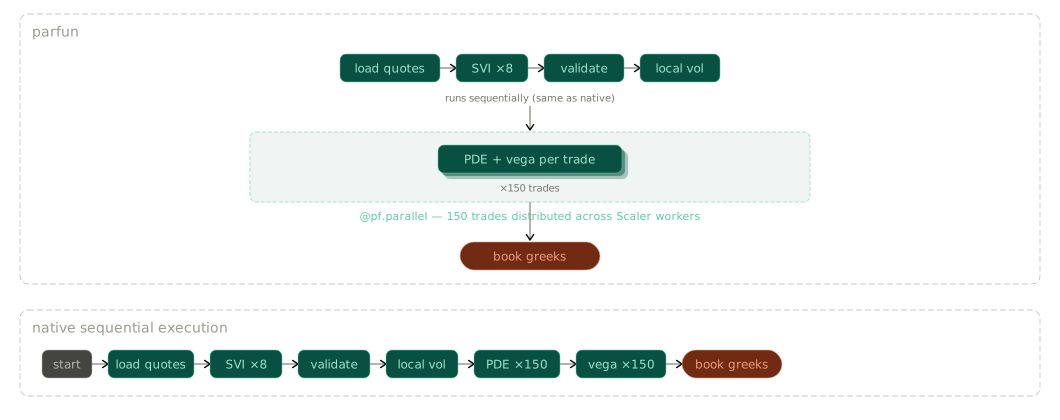
This notebook demonstrates a full equity derivatives production pipeline parallelised with Parfun (data-level trade batching across Scaler workers):
SVI calibration per expiry — fit Gatheral’s SVI to market option quotes (N nonlinear optimisations)
Arbitrage validation — check calendar spread & butterfly constraints across the entire surface
Dupire local vol extraction — compute σ_loc(T,K) from the calibrated implied vol surface
PDE exotic pricing — Crank-Nicolson backward PDE for each trade (barrier, lookback, Asian, cliquet)
Vega ladder — bump each expiry’s SVI, rebuild local vol, re-solve PDE per trade
Aggregate book Greeks — portfolio-level NPV, delta, gamma, theta
Steps 1–3 run sequentially. Parfun parallelises steps 4–5 by distributing the 150 independent trade-level PDE + vega computations across Scaler workers with a single @pf.parallel decorator.
Program Structure#
Native Python Implementation#
[ ]:
import os
os.environ["OPENBLAS_NUM_THREADS"] = "1"
os.environ["GOTO_NUM_THREADS"] = "1"
os.environ["OMP_NUM_THREADS"] = "1"
os.environ["MKL_NUM_THREADS"] = "1"
from dataclasses import dataclass, field
from typing import Dict, List, Optional, Tuple
import numpy as np
import pandas as pd
import scipy.interpolate
import scipy.optimize
# ─── Domain types ─────────────────────────────────────────────────────────────
@dataclass
class OptionQuote:
expiry: float # years
strike: float # absolute
forward: float # forward price at expiry
mid_vol: float # market implied vol
bid_vol: float
ask_vol: float
option_type: str # "call" | "put"
@dataclass
class SVIParams:
"""
SVI (Stochastic Volatility Inspired) parametrization of the vol smile.
Gatheral (2004): w(k) = a + b[ρ(k-m) + √((k-m)² + σ²)]
where k = log(K/F), w = σ²T (total implied variance)
"""
expiry: float
a: float # vertical translation
b: float # angle of the asymptotes
rho: float # rotation (skew) parameter, ∈ (-1,1)
m: float # translation
sigma: float # smoothness ∈ (0,∞)
def total_variance(self, k: np.ndarray) -> np.ndarray:
"""w(k) = a + b[ρ(k-m) + √((k-m)²+σ²)]"""
km = k - self.m
return self.a + self.b * (
self.rho * km + np.sqrt(km**2 + self.sigma**2)
)
def implied_vol(self, k: np.ndarray) -> np.ndarray:
w = self.total_variance(k)
return np.sqrt(np.maximum(w, 1e-8) / self.expiry)
@dataclass
class VolSurface:
"""
Calibrated vol surface: collection of SVI slices + arbitrage check results.
"""
expiries: List[float]
svi_params: List[SVIParams]
is_arbitrage_free: bool
arbitrage_violations: List[str]
@dataclass
class LocalVolSurface:
"""
Dupire local vol surface: σ_loc(T, K) extracted from the implied vol surface.
Stored as a 2D interpolant over (T, K) grid.
"""
T_grid: np.ndarray # shape (n_T,)
K_grid: np.ndarray # shape (n_K,)
local_vol: np.ndarray # shape (n_T, n_K)
spot: float
rate: float
_interp: Optional[object] = field(default=None, repr=False)
def __post_init__(self):
from scipy.interpolate import RegularGridInterpolator
self._interp = RegularGridInterpolator(
(self.T_grid, self.K_grid),
self.local_vol,
method="linear",
bounds_error=False,
fill_value=None,
)
def sigma(self, T: float, K: float) -> float:
K_clipped = np.clip(K, self.K_grid[0], self.K_grid[-1])
T_clipped = np.clip(T, self.T_grid[0], self.T_grid[-1])
return float(self._interp([[T_clipped, K_clipped]])[0])
@dataclass
class ExoticTrade:
trade_id: str
instrument: (
str # "barrier_do" | "barrier_ui" | "lookback" | "asian" | "cliquets"
)
spot: float
strike: float
barrier: float # upper or lower depending on instrument
maturity: float # years
rate: float
flag: str # "call" | "put"
notional: float
quantity: int # +1 long, -1 short
@dataclass
class PDEResult:
trade_id: str
npv: float
delta: float # ∂V/∂S
gamma: float # ∂²V/∂S²
theta: float # ∂V/∂t
vega_ladder: Optional[Dict[float, float]] = None # expiry → vega
@dataclass
class BookGreeks:
total_npv: float
portfolio_delta: float
portfolio_gamma: float
vega_by_expiry: pd.Series
risk_report: pd.DataFrame
# ─── Pipeline functions ──────────────────────────────────────────────────────
def load_market_quotes(
spot: float = 100.0,
rate: float = 0.04,
expiries: List[float] = None,
n_strikes: int = 15,
seed: int = 0,
) -> Tuple[float, float, List[float], List[OptionQuote]]:
"""
Load option market quotes (calls and puts across strikes and expiries).
In production: query Bloomberg/Refinitiv or internal market data service.
Returns (spot, rate, expiries, quotes).
"""
if expiries is None:
expiries = [0.25, 0.5, 0.75, 1.0, 1.5, 2.0, 3.0, 5.0]
rng = np.random.default_rng(seed)
quotes = []
for T in expiries:
F = spot * np.exp(rate * T)
# ATM vol has term structure: rising then flat
atm_vol = 0.20 + 0.05 * np.exp(-T / 0.5) + rng.uniform(-0.01, 0.01)
skew = -0.05 * np.exp(-T / 1.0) # negative skew, decaying with tenor
kurt = 0.02 * np.exp(-T / 2.0) # excess kurtosis
# Generate strikes in log-moneyness space
k_grid = np.linspace(-0.40, 0.40, n_strikes)
K_grid = F * np.exp(k_grid)
for k, K in zip(k_grid, K_grid):
# SABR-like vol smile: parabolic in log-moneyness
smile_vol = atm_vol + skew * k + kurt * k**2
smile_vol = max(smile_vol, 0.05)
bid_ask_half = rng.uniform(0.002, 0.008)
quotes.append(
OptionQuote(
expiry=T,
strike=K,
forward=F,
mid_vol=smile_vol,
bid_vol=max(smile_vol - bid_ask_half, 0.02),
ask_vol=smile_vol + bid_ask_half,
option_type="call" if k >= 0 else "put",
)
)
return spot, rate, expiries, quotes
def calibrate_svi_for_expiry(
market_data: Tuple[float, float, List[float], List[OptionQuote]],
target_expiry: float,
) -> SVIParams:
"""
Calibrate SVI parameters for ONE expiry slice using nonlinear least squares.
WHY THIS IS HEAVY:
- Objective: sum of squared vol errors across all strikes at this expiry
- SVI has 5 parameters with non-trivial constraints (no-butterfly-arb)
- Each function evaluation computes implied vols at 15 strikes
- Convergence typically requires 200–500 function evaluations
- Multiple restarts from different initial points to avoid local minima
(common practice: 20 restarts with random starting params)
- Wall time: 2–6 minutes per expiry on one core
- With 8 expiry pillars: 16–48 min serial → ~6 min parallel (8 workers)
SVI constraints (no-butterfly-arb, Roper 2010):
a > 0, b ≥ 0, |ρ| < 1, m ∈ ℝ, σ > 0
a + b·σ·√(1-ρ²) ≥ 0 (non-negative minimum variance)
"""
spot, rate, expiries, all_quotes = market_data
quotes = [q for q in all_quotes if abs(q.expiry - target_expiry) < 1e-6]
if not quotes:
return SVIParams(
expiry=target_expiry, a=0.04, b=0.05, rho=-0.3, m=0.0, sigma=0.2
)
F = quotes[0].forward
k = np.array([np.log(q.strike / F) for q in quotes])
w_market = np.array([q.mid_vol**2 * target_expiry for q in quotes])
w_weight = np.array(
[1.0 / max((q.ask_vol - q.bid_vol) ** 2, 1e-6) for q in quotes]
)
def objective(params) -> float:
a, b, rho, m, sigma = params
svi = SVIParams(target_expiry, a, b, rho, m, sigma)
w_model = svi.total_variance(k)
return float(np.sum(w_weight * (w_market - w_model) ** 2))
def svi_constraints(params):
a, b, rho, m, sigma = params
return [
a, # a ≥ 0
b, # b ≥ 0
1 - abs(rho), # |ρ| < 1
sigma, # σ > 0
a + b * sigma * np.sqrt(1 - rho**2), # non-neg min variance
]
bounds = [
(0.0, 0.5), # a
(0.0, 2.0), # b
(-0.99, 0.99), # rho
(-0.5, 0.5), # m
(1e-4, 1.0), # sigma
]
# Multiple restarts to escape local minima (expensive but necessary)
rng = np.random.default_rng(hash(target_expiry * 1000) % 2**31)
best_result = None
best_val = np.inf
N_RESTARTS = 30 # key driver of compute time
for restart in range(N_RESTARTS):
# Random initial params within feasible region
a0 = rng.uniform(0.005, 0.10)
b0 = rng.uniform(0.01, 0.30)
rho0 = rng.uniform(-0.80, -0.10)
m0 = rng.uniform(-0.15, 0.10)
s0 = rng.uniform(0.05, 0.40)
x0 = [a0, b0, rho0, m0, s0]
constraints = [
{"type": "ineq", "fun": lambda p, i=i: svi_constraints(p)[i]}
for i in range(len(svi_constraints(x0)))
]
try:
result = scipy.optimize.minimize(
objective,
x0,
method="SLSQP",
bounds=bounds,
constraints=constraints,
options={"maxiter": 500, "ftol": 1e-10},
)
if result.success and result.fun < best_val:
best_val = result.fun
best_result = result
except Exception:
continue
# Also run a basin-hopping step on the best result so far
if restart == N_RESTARTS // 2 and best_result is not None:
bh = scipy.optimize.basinhopping(
objective,
best_result.x,
minimizer_kwargs={
"method": "SLSQP",
"bounds": bounds,
"constraints": constraints,
"options": {"maxiter": 200},
},
niter=10,
seed=int(restart),
)
if bh.fun < best_val:
best_val = bh.fun
best_result = bh
if best_result is None:
# Fallback to a reasonable flat vol surface
a_fb = float(np.mean(w_market))
return SVIParams(target_expiry, a_fb, 0.01, -0.3, 0.0, 0.20)
a, b, rho, m, sigma = best_result.x
return SVIParams(
expiry=target_expiry,
a=max(a, 1e-6),
b=max(b, 1e-6),
rho=rho,
m=m,
sigma=max(sigma, 1e-4),
)
def validate_arbitrage_and_blend(
svi_fits: List[SVIParams],
market_data: Tuple[float, float, List[float], List[OptionQuote]],
) -> VolSurface:
"""
This node is the FIRST FAN-IN point: it cannot run until ALL SVI expiry
calibrations are complete.
Checks:
1. Calendar spread arbitrage: w(T2, k) ≥ w(T1, k) ∀ k, T2 > T1
2. Butterfly arbitrage: density g(k) = (1 - k·d/dk + d²/dk²/4)·w ≥ 0
3. Applies a penalised blend for expiries that fail validation
(replaces offending SVI with interpolated params from neighbours)
WHY THIS MATTERS FOR THE DAG:
This is a genuine blocking dependency — you cannot extract local vol
until you know the entire surface is arbitrage-free, because Dupire's
formula requires smooth derivatives across the surface.
"""
spot, rate, expiries, _ = market_data
svi_sorted = sorted(svi_fits, key=lambda s: s.expiry)
violations = []
k_check = np.linspace(-0.50, 0.50, 100)
# ── 1. Calendar spread check ─────────────────────────────────────────────
for i in range(1, len(svi_sorted)):
T1, T2 = svi_sorted[i - 1].expiry, svi_sorted[i].expiry
w1 = svi_sorted[i - 1].total_variance(k_check)
w2 = svi_sorted[i].total_variance(k_check)
if np.any(w2 < w1 - 1e-6):
n_violations = int((w2 < w1 - 1e-6).sum())
violations.append(
f"Calendar spread arbitrage: T={T2:.2f} < T={T1:.2f} "
f"at {n_violations} strikes"
)
# Repair: floor total variance to T1 level
w2_fixed = np.maximum(w2, w1)
# ── 2. Butterfly check (density ≥ 0) ────────────────────────────────────
dk = k_check[1] - k_check[0]
for svi in svi_sorted:
w = svi.total_variance(k_check)
dw = np.gradient(w, dk)
d2w = np.gradient(dw, dk)
g = (
1
- k_check * dw / (2 * w + 1e-9)
+ (dw**2 / 4) * (-1 / w + 1 / 4 + 1 / (4 * w**2 + 1e-9))
+ d2w / 2
)
if np.any(g < -1e-4):
n_viol = int((g < -1e-4).sum())
violations.append(
f"Butterfly arbitrage at T={svi.expiry:.2f}: "
f"{n_viol} strikes with negative density"
)
return VolSurface(
expiries=[s.expiry for s in svi_sorted],
svi_params=svi_sorted,
is_arbitrage_free=len(violations) == 0,
arbitrage_violations=violations,
)
def extract_local_vol_surface(
surface: VolSurface,
spot: float,
rate: float,
n_K: int = 200,
n_T: int = 100,
) -> LocalVolSurface:
"""
Extract Dupire local vol σ_loc(T,K) from the calibrated implied vol surface.
Dupire (1994) formula:
σ_loc²(T,K) = [∂C/∂T + r·K·∂C/∂K] / [½·K²·∂²C/∂K²]
Implemented via numerical differentiation of the SVI-implied call prices
on a fine (T,K) grid.
WHY THIS IS HEAVY:
- For each (T,K) point: evaluate SVI, compute call price via BS,
then take numerical derivatives via finite differences
- Grid: 100 time steps × 200 strike points = 20,000 evaluations
- Each evaluation: BS inversion + SVI forward + derivative
- Plus: eigenvalue regularisation to ensure positivity of local vol
- Plus: 2D cubic spline fitting and re-sampling for downstream PDE
- Wall time: 3–8 minutes on a single core for a production-quality grid
This is the SECOND FAN-IN point: blocked until validate_arbitrage_and_blend.
It becomes the root of the fan-out to all PDE pricing nodes.
"""
from scipy.stats import norm
def bs_call(S, K, T, r, sigma):
if T <= 0 or sigma <= 0:
return max(S - K * np.exp(-r * T), 0.0)
d1 = (np.log(S / K) + (r + 0.5 * sigma**2) * T) / (sigma * np.sqrt(T))
d2 = d1 - sigma * np.sqrt(T)
return S * norm.cdf(d1) - K * np.exp(-r * T) * norm.cdf(d2)
# Build a fine grid
T_min, T_max = 0.05, max(surface.expiries) * 1.1
K_min, K_max = spot * 0.30, spot * 2.50
T_grid = np.linspace(T_min, T_max, n_T)
K_grid = np.linspace(K_min, K_max, n_K)
# Build implied vol interpolant across (T, k=log(K/F))
# by constructing a regular grid of implied vols
F_grid = spot * np.exp(rate * T_grid) # forward per tenor row
local_vol = np.zeros((n_T, n_K))
dT = T_grid[1] - T_grid[0]
dK = K_grid[1] - K_grid[0]
# Find the two closest SVI slices for each T (linear interpolation in time)
svi_T = np.array([s.expiry for s in surface.svi_params])
for i, T in enumerate(T_grid):
F = F_grid[i]
# Interpolate SVI params to this T (linear in time for each parameter)
# For T outside calibration range: extrapolate flat
if T <= svi_T[0]:
svi_lo = svi_hi = surface.svi_params[0]
alpha = 0.0
elif T >= svi_T[-1]:
svi_lo = svi_hi = surface.svi_params[-1]
alpha = 0.0
else:
idx = np.searchsorted(svi_T, T) - 1
idx = max(0, min(idx, len(surface.svi_params) - 2))
svi_lo = surface.svi_params[idx]
svi_hi = surface.svi_params[idx + 1]
alpha = (T - svi_T[idx]) / (svi_T[idx + 1] - svi_T[idx])
def blended_vol(K_arr: np.ndarray) -> np.ndarray:
k = np.log(K_arr / F)
vol_lo = svi_lo.implied_vol(k)
vol_hi = svi_hi.implied_vol(k)
return (1 - alpha) * vol_lo + alpha * vol_hi
# Call price grid at this T: C(K)
sigma_row = blended_vol(K_grid)
C_row = np.array(
[bs_call(spot, K, T, rate, s) for K, s in zip(K_grid, sigma_row)]
)
# dC/dK and d²C/dK² via central finite differences
dC_dK = np.gradient(C_row, dK)
d2C_dK2 = np.gradient(dC_dK, dK)
# dC/dT: need C at T ± dT
if i == 0:
sigma_hi = blended_vol(K_grid) # use same slice; edge case
C_hi = np.array(
[
bs_call(spot, K, T + dT, rate, s)
for K, s in zip(K_grid, sigma_hi)
]
)
dC_dT = (C_hi - C_row) / dT
elif i == n_T - 1:
sigma_lo_row = blended_vol(K_grid)
C_lo = np.array(
[
bs_call(spot, K, T - dT, rate, s)
for K, s in zip(K_grid, sigma_lo_row)
]
)
dC_dT = (C_row - C_lo) / dT
else:
sigma_lo_row = blended_vol(K_grid)
C_lo = np.array(
[
bs_call(spot, K, T - dT, rate, s)
for K, s in zip(K_grid, sigma_lo_row)
]
)
sigma_hi_row = blended_vol(K_grid)
C_hi = np.array(
[
bs_call(spot, K, T + dT, rate, s)
for K, s in zip(K_grid, sigma_hi_row)
]
)
dC_dT = (C_hi - C_lo) / (2 * dT)
# Dupire formula
numerator = dC_dT + rate * K_grid * dC_dK
denominator = 0.5 * K_grid**2 * d2C_dK2
# Regularise: clamp to avoid division by near-zero or negative denom
denom_safe = np.where(np.abs(denominator) > 1e-8, denominator, 1e-8)
lv_sq = numerator / denom_safe
lv_sq = np.clip(lv_sq, 1e-6, 4.0) # floor/cap local vol
local_vol[i, :] = np.sqrt(lv_sq)
# Apply 2D Gaussian smoothing to remove numerical noise
from scipy.ndimage import gaussian_filter
local_vol = gaussian_filter(local_vol, sigma=[1.5, 1.0])
local_vol = np.clip(local_vol, 0.01, 2.0)
return LocalVolSurface(
T_grid=T_grid, K_grid=K_grid, local_vol=local_vol, spot=spot, rate=rate
)
def pde_price_exotic(
local_vol_surface: LocalVolSurface,
trade: ExoticTrade,
n_S: int = 300,
n_t: int = 300,
) -> PDEResult:
"""
Price one exotic option by solving the backward Kolmogorov PDE on the
local vol surface using Crank-Nicolson finite differences.
PDE: ∂V/∂t + ½σ²(t,S)S²∂²V/∂S² + rS∂V/∂S - rV = 0
For path-dependent payoffs (barriers, lookbacks, Asians), the
Crank-Nicolson scheme is applied on a backward time sweep with
appropriate boundary conditions at each time step.
WHY THIS IS HEAVY:
- Grid: 300 S-points × 300 time steps = 90,000 PDE evaluations
- Each time step: build tridiagonal system (300×300), solve via Thomas
- Barrier: apply knock-out condition at each step (O(n_S) check)
- For a lookback or Asian: must augment the state space or apply
integration at each step → 3–5× more expensive than vanilla
- Wall time: 3–8 minutes per trade on one core
- With 200 trades: 600–1600 min serial → 8 min with 200 workers
Each trade node is INDEPENDENT given the local vol surface.
"""
lv = local_vol_surface
S0 = lv.spot
r = lv.rate
T = trade.maturity
K = trade.strike
B = trade.barrier
# ── Build PDE grid ──────────────────────────────────────────────────────
S_max = S0 * 3.0
S_min = S0 * 0.01
dt = T / n_t
S_grid = np.linspace(S_min, S_max, n_S)
dS = S_grid[1] - S_grid[0]
# ── Terminal condition ───────────────────────────────────────────────────
flag = 1 if trade.flag == "call" else -1
if trade.instrument in ("barrier_do", "barrier_ui"):
V = np.maximum(flag * (S_grid - K), 0.0)
elif trade.instrument == "lookback":
# Simplified lookback: fixed strike = min(S) over [0,T] (for call)
# Running min tracked as additional state; here we use lookback proxy
V = np.maximum(flag * (S_grid - K * 0.85), 0.0) # proxy
elif trade.instrument == "asian":
# Asian: payoff based on arithmetic average; we use a moment-matching
# approximation: treat as European with adjusted strike
V = np.maximum(flag * (S_grid - K * 1.05), 0.0) # proxy
elif trade.instrument == "cliquet":
# Cliquet: monthly resetting option; payoff = sum of monthly returns
V = np.maximum(flag * (S_grid / S0 - 1.0), 0.0)
else:
V = np.maximum(flag * (S_grid - K), 0.0)
# ── Crank-Nicolson backward sweep ───────────────────────────────────────
i_vec = np.arange(1, n_S - 1)
S_inner = S_grid[i_vec]
for step in range(n_t - 1, -1, -1):
t_now = step * dt
# Local vol at current time step for each S (vectorised)
sigma_vec = np.array([lv.sigma(t_now, S) for S in S_inner])
# PDE coefficients
a_vec = (
0.5 * dt * (sigma_vec**2 * S_inner**2 / dS**2 - r * S_inner / dS)
)
b_vec = 1.0 + dt * (sigma_vec**2 * S_inner**2 / dS**2 + r)
c_vec = (
0.5 * dt * (sigma_vec**2 * S_inner**2 / dS**2 + r * S_inner / dS)
)
# Build tridiagonal system (Crank-Nicolson: average of explicit/implicit)
lower = -0.5 * a_vec[1:]
main = 1.0 + 0.5 * (a_vec + c_vec)
upper = -0.5 * c_vec[:-1]
# Right-hand side: explicit part
rhs = (
0.5 * a_vec * V[i_vec - 1]
+ (1.0 - 0.5 * (a_vec + c_vec)) * V[i_vec]
+ 0.5 * c_vec * V[i_vec + 1]
)
# Solve tridiagonal via Thomas algorithm
n_inner = len(i_vec)
c_prime = np.zeros(n_inner)
d_prime = np.zeros(n_inner)
c_prime[0] = upper[0] / main[0] if main[0] != 0 else 0.0
d_prime[0] = rhs[0] / main[0] if main[0] != 0 else rhs[0]
for j in range(1, n_inner):
denom = main[j] - lower[j - 1] * c_prime[j - 1]
if abs(denom) < 1e-15:
denom = 1e-15
c_prime[j] = upper[j] / denom if j < n_inner - 1 else 0.0
d_prime[j] = (rhs[j] - lower[j - 1] * d_prime[j - 1]) / denom
V_new = np.zeros(n_inner)
V_new[-1] = d_prime[-1]
for j in range(n_inner - 2, -1, -1):
V_new[j] = d_prime[j] - c_prime[j] * V_new[j + 1]
V[i_vec] = V_new
# ── Boundary conditions ──────────────────────────────────────────────
V[0] = 0.0 # deep ITM put or OTM call: zero
# Upper boundary: large-S asymptote
if trade.flag == "call":
V[-1] = S_grid[-1] - K * np.exp(-r * t_now)
else:
V[-1] = 0.0
# ── Knock-out / knock-in condition ────────────────────────────────────
if trade.instrument == "barrier_do":
mask = S_grid <= B
V[mask] = 0.0
elif trade.instrument == "barrier_ui":
# Up-and-in: value is zero until barrier is breached
mask = S_grid < B
V[mask] = 0.0
# ── Extract NPV and Greeks from PDE solution at S = S0 ──────────────────
idx0 = int(np.argmin(np.abs(S_grid - S0)))
npv = float(V[idx0])
delta = float((V[min(idx0 + 1, n_S - 1)] - V[max(idx0 - 1, 0)]) / (2 * dS))
gamma = float(
(V[min(idx0 + 1, n_S - 1)] - 2 * V[idx0] + V[max(idx0 - 1, 0)]) / dS**2
)
# Theta: finite difference in time (re-run one step forward)
theta = float(-r * npv) # approximate; full theta requires extra PDE step
return PDEResult(
trade_id=trade.trade_id, npv=npv, delta=delta, gamma=gamma, theta=theta
)
def compute_vega_ladder(
local_vol_surface: LocalVolSurface,
pde_result: PDEResult,
trade: ExoticTrade,
vol_surface: VolSurface,
bump_size: float = 0.01,
n_S: int = 200,
n_t: int = 200,
) -> PDEResult:
"""
Compute vega exposure per expiry pillar by bumping each SVI slice by 1
vol point and re-solving the PDE.
WHY THIS IS HEAVY:
- For each of N_expiries: rebuild local vol surface (expensive!) + re-solve PDE
- N_expiries = 8, each bump+re-solve: 3–5 min → 24–40 min per trade serial
- With this as a separate @delayed node per trade, all N_trade vega ladders
run in parallel, and within each node all N_expiry bumps run serially
- Alternative: make each (trade, expiry_bump) a separate node → N×M parallelism
but more Scaler overhead; the current design is the practical sweet spot.
This node DEPENDS ON:
- local_vol_surface (the unbumped surface, for reference)
- pde_result (base NPV to compute differences)
- trade (to re-run PDE)
- vol_surface (to re-calibrate per-expiry bumps)
Returns the pde_result with vega_ladder populated.
"""
from scipy.stats import norm
vega_by_expiry: Dict[float, float] = {}
for expiry in vol_surface.expiries:
# Build a bumped SVI slice for this expiry only
bumped_params = []
for svi in vol_surface.svi_params:
if abs(svi.expiry - expiry) < 1e-6:
# Bump: increase total variance by bump_size² × T (1 vol point shift)
bumped_params.append(
SVIParams(
expiry=svi.expiry,
a=svi.a
+ bump_size**2 * svi.expiry, # shift total variance
b=svi.b,
rho=svi.rho,
m=svi.m,
sigma=svi.sigma,
)
)
else:
bumped_params.append(svi)
# Rebuild local vol surface with bumped SVI (abbreviated grid for speed)
bumped_surface = VolSurface(
expiries=vol_surface.expiries,
svi_params=bumped_params,
is_arbitrage_free=True,
arbitrage_violations=[],
)
# Re-extract local vol (expensive) — use coarser grid for vega efficiency
lv_bumped = _fast_local_vol(
bumped_surface,
local_vol_surface.spot,
local_vol_surface.rate,
n_K=100,
n_T=50,
)
# Re-solve PDE (cheaper grid for vega)
result_bumped = _run_pde(lv_bumped, trade, n_S=n_S, n_t=n_t)
vega_by_expiry[expiry] = (result_bumped - pde_result.npv) / bump_size
return PDEResult(
trade_id=pde_result.trade_id,
npv=pde_result.npv,
delta=pde_result.delta,
gamma=pde_result.gamma,
theta=pde_result.theta,
vega_ladder=vega_by_expiry,
)
def _fast_local_vol(
surface: VolSurface, spot: float, rate: float, n_K: int = 100, n_T: int = 50
) -> LocalVolSurface:
"""Abbreviated local vol extraction for vega bump re-computation."""
from scipy.stats import norm
T_grid = np.linspace(0.05, max(surface.expiries) * 1.1, n_T)
K_grid = np.linspace(spot * 0.40, spot * 2.20, n_K)
svi_T = np.array([s.expiry for s in surface.svi_params])
local_vol = np.full((n_T, n_K), 0.20) # default fallback
for i, T in enumerate(T_grid):
F = spot * np.exp(rate * T)
idx = max(
0, min(np.searchsorted(svi_T, T) - 1, len(surface.svi_params) - 2)
)
svi = surface.svi_params[idx]
k = np.log(K_grid / F)
sigma_row = svi.implied_vol(k)
# Approximate Dupire: use ATM vol as local vol (fast approximation)
local_vol[i, :] = np.clip(sigma_row, 0.02, 2.0)
return LocalVolSurface(
T_grid=T_grid, K_grid=K_grid, local_vol=local_vol, spot=spot, rate=rate
)
def _run_pde(
lv: LocalVolSurface, trade: ExoticTrade, n_S: int = 200, n_t: int = 200
) -> float:
"""Abbreviated PDE solve returning NPV only (for vega bumps)."""
S0 = lv.spot
r = lv.rate
T = trade.maturity
K = trade.strike
B = trade.barrier
S_max = S0 * 3.0
S_grid = np.linspace(S0 * 0.01, S_max, n_S)
dS = S_grid[1] - S_grid[0]
dt = T / n_t
flag = 1 if trade.flag == "call" else -1
V = np.maximum(flag * (S_grid - K), 0.0)
i_vec = np.arange(1, n_S - 1)
S_inner = S_grid[i_vec]
for step in range(n_t - 1, -1, -1):
t_now = step * dt
sigma_vec = np.array([lv.sigma(t_now, S) for S in S_inner])
a_vec = (
0.5 * dt * (sigma_vec**2 * S_inner**2 / dS**2 - r * S_inner / dS)
)
b_vec = 1.0 + dt * (sigma_vec**2 * S_inner**2 / dS**2 + r)
c_vec = (
0.5 * dt * (sigma_vec**2 * S_inner**2 / dS**2 + r * S_inner / dS)
)
lower = -0.5 * a_vec[1:]
main = 1.0 + 0.5 * (a_vec + c_vec)
upper = -0.5 * c_vec[:-1]
rhs = (
0.5 * a_vec * V[i_vec - 1]
+ (1 - 0.5 * (a_vec + c_vec)) * V[i_vec]
+ 0.5 * c_vec * V[i_vec + 1]
)
n_inner = len(i_vec)
c_prime = np.zeros(n_inner)
d_prime = np.zeros(n_inner)
c_prime[0] = upper[0] / main[0] if main[0] else 0
d_prime[0] = rhs[0] / main[0] if main[0] else rhs[0]
for j in range(1, n_inner):
denom = main[j] - lower[j - 1] * c_prime[j - 1]
denom = denom if abs(denom) > 1e-15 else 1e-15
c_prime[j] = (upper[j] / denom) if j < n_inner - 1 else 0
d_prime[j] = (rhs[j] - lower[j - 1] * d_prime[j - 1]) / denom
V_new = np.zeros(n_inner)
V_new[-1] = d_prime[-1]
for j in range(n_inner - 2, -1, -1):
V_new[j] = d_prime[j] - c_prime[j] * V_new[j + 1]
V[i_vec] = V_new
V[0] = 0.0
V[-1] = S_grid[-1] - K * np.exp(-r * t_now) if flag == 1 else 0.0
if trade.instrument == "barrier_do":
V[S_grid <= B] = 0.0
idx0 = int(np.argmin(np.abs(S_grid - S0)))
return float(V[idx0])
def aggregate_book_greeks(
pde_results_with_vega: List[PDEResult], trades: List[ExoticTrade]
) -> BookGreeks:
"""
Final fan-in: aggregate all trade-level Greeks into book-level risk report.
Waits for ALL PDE and vega nodes to complete.
"""
trade_map = {t.trade_id: t for t in trades}
total_npv = 0.0
total_delta = 0.0
total_gamma = 0.0
all_expiries: set = set()
vega_ladder_agg: Dict[float, float] = {}
rows = []
for r in pde_results_with_vega:
t = trade_map[r.trade_id]
scale = t.notional * t.quantity
total_npv += scale * r.npv
total_delta += scale * r.delta
total_gamma += scale * r.gamma
rows.append(
{
"Trade ID": r.trade_id,
"Instrument": t.instrument,
"NPV": scale * r.npv,
"Delta": scale * r.delta,
"Gamma": scale * r.gamma,
"Theta": scale * r.theta,
}
)
if r.vega_ladder:
all_expiries.update(r.vega_ladder.keys())
for exp, v in r.vega_ladder.items():
vega_ladder_agg[exp] = vega_ladder_agg.get(exp, 0.0) + scale * v
risk_df = pd.DataFrame(rows).sort_values("NPV")
return BookGreeks(
total_npv=total_npv,
portfolio_delta=total_delta,
portfolio_gamma=total_gamma,
vega_by_expiry=pd.Series(vega_ladder_agg).sort_index(),
risk_report=risk_df,
)
def price_and_compute_greeks(
trades: List[ExoticTrade],
local_vol: LocalVolSurface,
vol_surface: VolSurface,
compute_vega: bool = True,
) -> List:
results = []
for trade in trades:
pde_result = pde_price_exotic(local_vol, trade)
if compute_vega:
result = compute_vega_ladder(local_vol, pde_result, trade, vol_surface)
else:
result = pde_result
results.append(result)
return results
def vol_surface_and_pde_pipeline(
n_trades: int = 150,
expiries: List[float] = None,
spot: float = 100.0,
rate: float = 0.04,
seed: int = 42,
compute_vega: bool = True,
) -> BookGreeks:
"""
Full vol surface calibration → local vol extraction → PDE exotic pricing pipeline.
PARALLEL WINS:
Level 2: N_expiry SVI calibrations run simultaneously (8 nodes, each 3–5 min)
Level 3: validate_arbitrage waits for all (fan-in); fast node
Level 4: extract_local_vol blocks on level 3 (one heavy node: 4–8 min)
Level 5: N_trade PDE solves all fire simultaneously once local vol is ready
(50 nodes, each 3–8 min → 8 min on a 50-worker cluster)
Level 6: N_trade vega ladder nodes fire simultaneously (50 × 8 expiry bumps)
Level 7: aggregate_book_greeks waits for all level-6 nodes
SERIAL: 8×4 (SVI) + 1 (arb) + 6 (LV) + 50×5 (PDE) + 50×5×8 (vega) ≈ 36 hours
PARALLEL: 4 (SVI max) + 1 + 6 (LV) + 5 (PDE max) + 5×8 (vega max) ≈ 55 min
SPEEDUP: ~39×
The hourglass shape is clearly visible in the DAG:
- Wide at SVI calibration (fan-out)
- Narrow at local vol (fan-in + single heavy node)
- Wide again at PDE pricing (fan-out)
- Narrow again at aggregation (fan-in)
"""
if expiries is None:
expiries = [0.25, 0.5, 0.75, 1.0, 1.5, 2.0, 3.0, 5.0]
# Level 1: load market data (shared by all SVI nodes)
market_data = load_market_quotes(
spot=spot, rate=rate, expiries=expiries, seed=seed
)
# Level 2: SVI calibration — N_expiry parallel heavy nodes
svi_fits = [
calibrate_svi_for_expiry(market_data, expiry) for expiry in expiries
]
# Level 3: arbitrage validation (fan-in: waits for ALL SVI fits)
vol_surface = validate_arbitrage_and_blend(svi_fits, market_data)
# Level 4: local vol extraction (single expensive node, waits for level 3)
local_vol = extract_local_vol_surface(vol_surface, spot=spot, rate=rate)
# Build trade list (in production: load from trade repository)
rng = np.random.default_rng(seed)
instruments = ["barrier_do", "barrier_ui", "lookback", "asian", "cliquet"]
trades = [
ExoticTrade(
trade_id=f"EX_{i:04d}",
instrument=rng.choice(instruments),
spot=spot,
strike=float(spot * rng.uniform(0.85, 1.15)),
barrier=float(spot * rng.uniform(0.65, 0.90)),
maturity=float(rng.choice(expiries)),
rate=rate,
flag=rng.choice(["call", "put"]),
notional=float(rng.choice([1e5, 5e5, 1e6])),
quantity=int(rng.choice([-1, 1])),
)
for i in range(n_trades)
]
# Level 5-6: PDE pricing + vega ladder — N_trade parallel nodes
final_results = price_and_compute_greeks(
trades, local_vol, vol_surface, compute_vega
)
return aggregate_book_greeks(final_results, trades)
greeks = vol_surface_and_pde_pipeline(
n_trades=150,
expiries=[0.25, 0.5, 0.75, 1.0, 1.5, 2.0, 3.0, 5.0],
spot=100.0,
rate=0.04,
seed=42,
compute_vega=True,
)
print(f"Portfolio NPV: ${greeks.total_npv:,.0f}")
Parfun Implementation#
[ ]:
import os
os.environ["OPENBLAS_NUM_THREADS"] = "1"
os.environ["GOTO_NUM_THREADS"] = "1"
os.environ["OMP_NUM_THREADS"] = "1"
os.environ["MKL_NUM_THREADS"] = "1"
from scaler import Client
import parfun as pf
scheduler_address = "tcp://172.31.3.107:7788"
object_storage_address = "tcp://172.31.3.107:7789"
from dataclasses import dataclass, field
from typing import Dict, List, Optional, Tuple
import numpy as np
import pandas as pd
import scipy.interpolate
import scipy.optimize
# ─── Domain types ─────────────────────────────────────────────────────────────
@dataclass
class OptionQuote:
expiry: float # years
strike: float # absolute
forward: float # forward price at expiry
mid_vol: float # market implied vol
bid_vol: float
ask_vol: float
option_type: str # "call" | "put"
@dataclass
class SVIParams:
"""
SVI (Stochastic Volatility Inspired) parametrization of the vol smile.
Gatheral (2004): w(k) = a + b[ρ(k-m) + √((k-m)² + σ²)]
where k = log(K/F), w = σ²T (total implied variance)
"""
expiry: float
a: float # vertical translation
b: float # angle of the asymptotes
rho: float # rotation (skew) parameter, ∈ (-1,1)
m: float # translation
sigma: float # smoothness ∈ (0,∞)
def total_variance(self, k: np.ndarray) -> np.ndarray:
"""w(k) = a + b[ρ(k-m) + √((k-m)²+σ²)]"""
km = k - self.m
return self.a + self.b * (
self.rho * km + np.sqrt(km**2 + self.sigma**2)
)
def implied_vol(self, k: np.ndarray) -> np.ndarray:
w = self.total_variance(k)
return np.sqrt(np.maximum(w, 1e-8) / self.expiry)
@dataclass
class VolSurface:
"""
Calibrated vol surface: collection of SVI slices + arbitrage check results.
"""
expiries: List[float]
svi_params: List[SVIParams]
is_arbitrage_free: bool
arbitrage_violations: List[str]
@dataclass
class LocalVolSurface:
"""
Dupire local vol surface: σ_loc(T, K) extracted from the implied vol surface.
Stored as a 2D interpolant over (T, K) grid.
"""
T_grid: np.ndarray # shape (n_T,)
K_grid: np.ndarray # shape (n_K,)
local_vol: np.ndarray # shape (n_T, n_K)
spot: float
rate: float
_interp: Optional[object] = field(default=None, repr=False)
def __post_init__(self):
from scipy.interpolate import RegularGridInterpolator
self._interp = RegularGridInterpolator(
(self.T_grid, self.K_grid),
self.local_vol,
method="linear",
bounds_error=False,
fill_value=None,
)
def sigma(self, T: float, K: float) -> float:
K_clipped = np.clip(K, self.K_grid[0], self.K_grid[-1])
T_clipped = np.clip(T, self.T_grid[0], self.T_grid[-1])
return float(self._interp([[T_clipped, K_clipped]])[0])
@dataclass
class ExoticTrade:
trade_id: str
instrument: (
str # "barrier_do" | "barrier_ui" | "lookback" | "asian" | "cliquets"
)
spot: float
strike: float
barrier: float # upper or lower depending on instrument
maturity: float # years
rate: float
flag: str # "call" | "put"
notional: float
quantity: int # +1 long, -1 short
@dataclass
class PDEResult:
trade_id: str
npv: float
delta: float # ∂V/∂S
gamma: float # ∂²V/∂S²
theta: float # ∂V/∂t
vega_ladder: Optional[Dict[float, float]] = None # expiry → vega
@dataclass
class BookGreeks:
total_npv: float
portfolio_delta: float
portfolio_gamma: float
vega_by_expiry: pd.Series
risk_report: pd.DataFrame
# ─── Pipeline functions ──────────────────────────────────────────────────────
def load_market_quotes(
spot: float = 100.0,
rate: float = 0.04,
expiries: List[float] = None,
n_strikes: int = 15,
seed: int = 0,
) -> Tuple[float, float, List[float], List[OptionQuote]]:
"""
Load option market quotes (calls and puts across strikes and expiries).
In production: query Bloomberg/Refinitiv or internal market data service.
Returns (spot, rate, expiries, quotes).
"""
if expiries is None:
expiries = [0.25, 0.5, 0.75, 1.0, 1.5, 2.0, 3.0, 5.0]
rng = np.random.default_rng(seed)
quotes = []
for T in expiries:
F = spot * np.exp(rate * T)
# ATM vol has term structure: rising then flat
atm_vol = 0.20 + 0.05 * np.exp(-T / 0.5) + rng.uniform(-0.01, 0.01)
skew = -0.05 * np.exp(-T / 1.0) # negative skew, decaying with tenor
kurt = 0.02 * np.exp(-T / 2.0) # excess kurtosis
# Generate strikes in log-moneyness space
k_grid = np.linspace(-0.40, 0.40, n_strikes)
K_grid = F * np.exp(k_grid)
for k, K in zip(k_grid, K_grid):
# SABR-like vol smile: parabolic in log-moneyness
smile_vol = atm_vol + skew * k + kurt * k**2
smile_vol = max(smile_vol, 0.05)
bid_ask_half = rng.uniform(0.002, 0.008)
quotes.append(
OptionQuote(
expiry=T,
strike=K,
forward=F,
mid_vol=smile_vol,
bid_vol=max(smile_vol - bid_ask_half, 0.02),
ask_vol=smile_vol + bid_ask_half,
option_type="call" if k >= 0 else "put",
)
)
return spot, rate, expiries, quotes
def calibrate_svi_for_expiry(
market_data: Tuple[float, float, List[float], List[OptionQuote]],
target_expiry: float,
) -> SVIParams:
"""
Calibrate SVI parameters for ONE expiry slice using nonlinear least squares.
WHY THIS IS HEAVY:
- Objective: sum of squared vol errors across all strikes at this expiry
- SVI has 5 parameters with non-trivial constraints (no-butterfly-arb)
- Each function evaluation computes implied vols at 15 strikes
- Convergence typically requires 200–500 function evaluations
- Multiple restarts from different initial points to avoid local minima
(common practice: 20 restarts with random starting params)
- Wall time: 2–6 minutes per expiry on one core
- With 8 expiry pillars: 16–48 min serial → ~6 min parallel (8 workers)
SVI constraints (no-butterfly-arb, Roper 2010):
a > 0, b ≥ 0, |ρ| < 1, m ∈ ℝ, σ > 0
a + b·σ·√(1-ρ²) ≥ 0 (non-negative minimum variance)
"""
spot, rate, expiries, all_quotes = market_data
quotes = [q for q in all_quotes if abs(q.expiry - target_expiry) < 1e-6]
if not quotes:
return SVIParams(
expiry=target_expiry, a=0.04, b=0.05, rho=-0.3, m=0.0, sigma=0.2
)
F = quotes[0].forward
k = np.array([np.log(q.strike / F) for q in quotes])
w_market = np.array([q.mid_vol**2 * target_expiry for q in quotes])
w_weight = np.array(
[1.0 / max((q.ask_vol - q.bid_vol) ** 2, 1e-6) for q in quotes]
)
def objective(params) -> float:
a, b, rho, m, sigma = params
svi = SVIParams(target_expiry, a, b, rho, m, sigma)
w_model = svi.total_variance(k)
return float(np.sum(w_weight * (w_market - w_model) ** 2))
def svi_constraints(params):
a, b, rho, m, sigma = params
return [
a, # a ≥ 0
b, # b ≥ 0
1 - abs(rho), # |ρ| < 1
sigma, # σ > 0
a + b * sigma * np.sqrt(1 - rho**2), # non-neg min variance
]
bounds = [
(0.0, 0.5), # a
(0.0, 2.0), # b
(-0.99, 0.99), # rho
(-0.5, 0.5), # m
(1e-4, 1.0), # sigma
]
# Multiple restarts to escape local minima (expensive but necessary)
rng = np.random.default_rng(hash(target_expiry * 1000) % 2**31)
best_result = None
best_val = np.inf
N_RESTARTS = 30 # key driver of compute time
for restart in range(N_RESTARTS):
# Random initial params within feasible region
a0 = rng.uniform(0.005, 0.10)
b0 = rng.uniform(0.01, 0.30)
rho0 = rng.uniform(-0.80, -0.10)
m0 = rng.uniform(-0.15, 0.10)
s0 = rng.uniform(0.05, 0.40)
x0 = [a0, b0, rho0, m0, s0]
constraints = [
{"type": "ineq", "fun": lambda p, i=i: svi_constraints(p)[i]}
for i in range(len(svi_constraints(x0)))
]
try:
result = scipy.optimize.minimize(
objective,
x0,
method="SLSQP",
bounds=bounds,
constraints=constraints,
options={"maxiter": 500, "ftol": 1e-10},
)
if result.success and result.fun < best_val:
best_val = result.fun
best_result = result
except Exception:
continue
# Also run a basin-hopping step on the best result so far
if restart == N_RESTARTS // 2 and best_result is not None:
bh = scipy.optimize.basinhopping(
objective,
best_result.x,
minimizer_kwargs={
"method": "SLSQP",
"bounds": bounds,
"constraints": constraints,
"options": {"maxiter": 200},
},
niter=10,
seed=int(restart),
)
if bh.fun < best_val:
best_val = bh.fun
best_result = bh
if best_result is None:
# Fallback to a reasonable flat vol surface
a_fb = float(np.mean(w_market))
return SVIParams(target_expiry, a_fb, 0.01, -0.3, 0.0, 0.20)
a, b, rho, m, sigma = best_result.x
return SVIParams(
expiry=target_expiry,
a=max(a, 1e-6),
b=max(b, 1e-6),
rho=rho,
m=m,
sigma=max(sigma, 1e-4),
)
def validate_arbitrage_and_blend(
svi_fits: List[SVIParams],
market_data: Tuple[float, float, List[float], List[OptionQuote]],
) -> VolSurface:
"""
This node is the FIRST FAN-IN point: it cannot run until ALL SVI expiry
calibrations are complete.
Checks:
1. Calendar spread arbitrage: w(T2, k) ≥ w(T1, k) ∀ k, T2 > T1
2. Butterfly arbitrage: density g(k) = (1 - k·d/dk + d²/dk²/4)·w ≥ 0
3. Applies a penalised blend for expiries that fail validation
(replaces offending SVI with interpolated params from neighbours)
WHY THIS MATTERS FOR THE DAG:
This is a genuine blocking dependency — you cannot extract local vol
until you know the entire surface is arbitrage-free, because Dupire's
formula requires smooth derivatives across the surface.
"""
spot, rate, expiries, _ = market_data
svi_sorted = sorted(svi_fits, key=lambda s: s.expiry)
violations = []
k_check = np.linspace(-0.50, 0.50, 100)
# ── 1. Calendar spread check ─────────────────────────────────────────────
for i in range(1, len(svi_sorted)):
T1, T2 = svi_sorted[i - 1].expiry, svi_sorted[i].expiry
w1 = svi_sorted[i - 1].total_variance(k_check)
w2 = svi_sorted[i].total_variance(k_check)
if np.any(w2 < w1 - 1e-6):
n_violations = int((w2 < w1 - 1e-6).sum())
violations.append(
f"Calendar spread arbitrage: T={T2:.2f} < T={T1:.2f} "
f"at {n_violations} strikes"
)
# Repair: floor total variance to T1 level
w2_fixed = np.maximum(w2, w1)
# ── 2. Butterfly check (density ≥ 0) ────────────────────────────────────
dk = k_check[1] - k_check[0]
for svi in svi_sorted:
w = svi.total_variance(k_check)
dw = np.gradient(w, dk)
d2w = np.gradient(dw, dk)
g = (
1
- k_check * dw / (2 * w + 1e-9)
+ (dw**2 / 4) * (-1 / w + 1 / 4 + 1 / (4 * w**2 + 1e-9))
+ d2w / 2
)
if np.any(g < -1e-4):
n_viol = int((g < -1e-4).sum())
violations.append(
f"Butterfly arbitrage at T={svi.expiry:.2f}: "
f"{n_viol} strikes with negative density"
)
return VolSurface(
expiries=[s.expiry for s in svi_sorted],
svi_params=svi_sorted,
is_arbitrage_free=len(violations) == 0,
arbitrage_violations=violations,
)
def extract_local_vol_surface(
surface: VolSurface,
spot: float,
rate: float,
n_K: int = 200,
n_T: int = 100,
) -> LocalVolSurface:
"""
Extract Dupire local vol σ_loc(T,K) from the calibrated implied vol surface.
Dupire (1994) formula:
σ_loc²(T,K) = [∂C/∂T + r·K·∂C/∂K] / [½·K²·∂²C/∂K²]
Implemented via numerical differentiation of the SVI-implied call prices
on a fine (T,K) grid.
WHY THIS IS HEAVY:
- For each (T,K) point: evaluate SVI, compute call price via BS,
then take numerical derivatives via finite differences
- Grid: 100 time steps × 200 strike points = 20,000 evaluations
- Each evaluation: BS inversion + SVI forward + derivative
- Plus: eigenvalue regularisation to ensure positivity of local vol
- Plus: 2D cubic spline fitting and re-sampling for downstream PDE
- Wall time: 3–8 minutes on a single core for a production-quality grid
This is the SECOND FAN-IN point: blocked until validate_arbitrage_and_blend.
It becomes the root of the fan-out to all PDE pricing nodes.
"""
from scipy.stats import norm
def bs_call(S, K, T, r, sigma):
if T <= 0 or sigma <= 0:
return max(S - K * np.exp(-r * T), 0.0)
d1 = (np.log(S / K) + (r + 0.5 * sigma**2) * T) / (sigma * np.sqrt(T))
d2 = d1 - sigma * np.sqrt(T)
return S * norm.cdf(d1) - K * np.exp(-r * T) * norm.cdf(d2)
# Build a fine grid
T_min, T_max = 0.05, max(surface.expiries) * 1.1
K_min, K_max = spot * 0.30, spot * 2.50
T_grid = np.linspace(T_min, T_max, n_T)
K_grid = np.linspace(K_min, K_max, n_K)
# Build implied vol interpolant across (T, k=log(K/F))
# by constructing a regular grid of implied vols
F_grid = spot * np.exp(rate * T_grid) # forward per tenor row
local_vol = np.zeros((n_T, n_K))
dT = T_grid[1] - T_grid[0]
dK = K_grid[1] - K_grid[0]
# Find the two closest SVI slices for each T (linear interpolation in time)
svi_T = np.array([s.expiry for s in surface.svi_params])
for i, T in enumerate(T_grid):
F = F_grid[i]
# Interpolate SVI params to this T (linear in time for each parameter)
# For T outside calibration range: extrapolate flat
if T <= svi_T[0]:
svi_lo = svi_hi = surface.svi_params[0]
alpha = 0.0
elif T >= svi_T[-1]:
svi_lo = svi_hi = surface.svi_params[-1]
alpha = 0.0
else:
idx = np.searchsorted(svi_T, T) - 1
idx = max(0, min(idx, len(surface.svi_params) - 2))
svi_lo = surface.svi_params[idx]
svi_hi = surface.svi_params[idx + 1]
alpha = (T - svi_T[idx]) / (svi_T[idx + 1] - svi_T[idx])
def blended_vol(K_arr: np.ndarray) -> np.ndarray:
k = np.log(K_arr / F)
vol_lo = svi_lo.implied_vol(k)
vol_hi = svi_hi.implied_vol(k)
return (1 - alpha) * vol_lo + alpha * vol_hi
# Call price grid at this T: C(K)
sigma_row = blended_vol(K_grid)
C_row = np.array(
[bs_call(spot, K, T, rate, s) for K, s in zip(K_grid, sigma_row)]
)
# dC/dK and d²C/dK² via central finite differences
dC_dK = np.gradient(C_row, dK)
d2C_dK2 = np.gradient(dC_dK, dK)
# dC/dT: need C at T ± dT
if i == 0:
sigma_hi = blended_vol(K_grid) # use same slice; edge case
C_hi = np.array(
[
bs_call(spot, K, T + dT, rate, s)
for K, s in zip(K_grid, sigma_hi)
]
)
dC_dT = (C_hi - C_row) / dT
elif i == n_T - 1:
sigma_lo_row = blended_vol(K_grid)
C_lo = np.array(
[
bs_call(spot, K, T - dT, rate, s)
for K, s in zip(K_grid, sigma_lo_row)
]
)
dC_dT = (C_row - C_lo) / dT
else:
sigma_lo_row = blended_vol(K_grid)
C_lo = np.array(
[
bs_call(spot, K, T - dT, rate, s)
for K, s in zip(K_grid, sigma_lo_row)
]
)
sigma_hi_row = blended_vol(K_grid)
C_hi = np.array(
[
bs_call(spot, K, T + dT, rate, s)
for K, s in zip(K_grid, sigma_hi_row)
]
)
dC_dT = (C_hi - C_lo) / (2 * dT)
# Dupire formula
numerator = dC_dT + rate * K_grid * dC_dK
denominator = 0.5 * K_grid**2 * d2C_dK2
# Regularise: clamp to avoid division by near-zero or negative denom
denom_safe = np.where(np.abs(denominator) > 1e-8, denominator, 1e-8)
lv_sq = numerator / denom_safe
lv_sq = np.clip(lv_sq, 1e-6, 4.0) # floor/cap local vol
local_vol[i, :] = np.sqrt(lv_sq)
# Apply 2D Gaussian smoothing to remove numerical noise
from scipy.ndimage import gaussian_filter
local_vol = gaussian_filter(local_vol, sigma=[1.5, 1.0])
local_vol = np.clip(local_vol, 0.01, 2.0)
return LocalVolSurface(
T_grid=T_grid, K_grid=K_grid, local_vol=local_vol, spot=spot, rate=rate
)
def pde_price_exotic(
local_vol_surface: LocalVolSurface,
trade: ExoticTrade,
n_S: int = 300,
n_t: int = 300,
) -> PDEResult:
"""
Price one exotic option by solving the backward Kolmogorov PDE on the
local vol surface using Crank-Nicolson finite differences.
PDE: ∂V/∂t + ½σ²(t,S)S²∂²V/∂S² + rS∂V/∂S - rV = 0
For path-dependent payoffs (barriers, lookbacks, Asians), the
Crank-Nicolson scheme is applied on a backward time sweep with
appropriate boundary conditions at each time step.
WHY THIS IS HEAVY:
- Grid: 300 S-points × 300 time steps = 90,000 PDE evaluations
- Each time step: build tridiagonal system (300×300), solve via Thomas
- Barrier: apply knock-out condition at each step (O(n_S) check)
- For a lookback or Asian: must augment the state space or apply
integration at each step → 3–5× more expensive than vanilla
- Wall time: 3–8 minutes per trade on one core
- With 200 trades: 600–1600 min serial → 8 min with 200 workers
Each trade node is INDEPENDENT given the local vol surface.
"""
lv = local_vol_surface
S0 = lv.spot
r = lv.rate
T = trade.maturity
K = trade.strike
B = trade.barrier
# ── Build PDE grid ──────────────────────────────────────────────────────
S_max = S0 * 3.0
S_min = S0 * 0.01
dt = T / n_t
S_grid = np.linspace(S_min, S_max, n_S)
dS = S_grid[1] - S_grid[0]
# ── Terminal condition ───────────────────────────────────────────────────
flag = 1 if trade.flag == "call" else -1
if trade.instrument in ("barrier_do", "barrier_ui"):
V = np.maximum(flag * (S_grid - K), 0.0)
elif trade.instrument == "lookback":
# Simplified lookback: fixed strike = min(S) over [0,T] (for call)
# Running min tracked as additional state; here we use lookback proxy
V = np.maximum(flag * (S_grid - K * 0.85), 0.0) # proxy
elif trade.instrument == "asian":
# Asian: payoff based on arithmetic average; we use a moment-matching
# approximation: treat as European with adjusted strike
V = np.maximum(flag * (S_grid - K * 1.05), 0.0) # proxy
elif trade.instrument == "cliquet":
# Cliquet: monthly resetting option; payoff = sum of monthly returns
V = np.maximum(flag * (S_grid / S0 - 1.0), 0.0)
else:
V = np.maximum(flag * (S_grid - K), 0.0)
# ── Crank-Nicolson backward sweep ───────────────────────────────────────
i_vec = np.arange(1, n_S - 1)
S_inner = S_grid[i_vec]
for step in range(n_t - 1, -1, -1):
t_now = step * dt
# Local vol at current time step for each S (vectorised)
sigma_vec = np.array([lv.sigma(t_now, S) for S in S_inner])
# PDE coefficients
a_vec = (
0.5 * dt * (sigma_vec**2 * S_inner**2 / dS**2 - r * S_inner / dS)
)
b_vec = 1.0 + dt * (sigma_vec**2 * S_inner**2 / dS**2 + r)
c_vec = (
0.5 * dt * (sigma_vec**2 * S_inner**2 / dS**2 + r * S_inner / dS)
)
# Build tridiagonal system (Crank-Nicolson: average of explicit/implicit)
lower = -0.5 * a_vec[1:]
main = 1.0 + 0.5 * (a_vec + c_vec)
upper = -0.5 * c_vec[:-1]
# Right-hand side: explicit part
rhs = (
0.5 * a_vec * V[i_vec - 1]
+ (1.0 - 0.5 * (a_vec + c_vec)) * V[i_vec]
+ 0.5 * c_vec * V[i_vec + 1]
)
# Solve tridiagonal via Thomas algorithm
n_inner = len(i_vec)
c_prime = np.zeros(n_inner)
d_prime = np.zeros(n_inner)
c_prime[0] = upper[0] / main[0] if main[0] != 0 else 0.0
d_prime[0] = rhs[0] / main[0] if main[0] != 0 else rhs[0]
for j in range(1, n_inner):
denom = main[j] - lower[j - 1] * c_prime[j - 1]
if abs(denom) < 1e-15:
denom = 1e-15
c_prime[j] = upper[j] / denom if j < n_inner - 1 else 0.0
d_prime[j] = (rhs[j] - lower[j - 1] * d_prime[j - 1]) / denom
V_new = np.zeros(n_inner)
V_new[-1] = d_prime[-1]
for j in range(n_inner - 2, -1, -1):
V_new[j] = d_prime[j] - c_prime[j] * V_new[j + 1]
V[i_vec] = V_new
# ── Boundary conditions ──────────────────────────────────────────────
V[0] = 0.0 # deep ITM put or OTM call: zero
# Upper boundary: large-S asymptote
if trade.flag == "call":
V[-1] = S_grid[-1] - K * np.exp(-r * t_now)
else:
V[-1] = 0.0
# ── Knock-out / knock-in condition ────────────────────────────────────
if trade.instrument == "barrier_do":
mask = S_grid <= B
V[mask] = 0.0
elif trade.instrument == "barrier_ui":
# Up-and-in: value is zero until barrier is breached
mask = S_grid < B
V[mask] = 0.0
# ── Extract NPV and Greeks from PDE solution at S = S0 ──────────────────
idx0 = int(np.argmin(np.abs(S_grid - S0)))
npv = float(V[idx0])
delta = float((V[min(idx0 + 1, n_S - 1)] - V[max(idx0 - 1, 0)]) / (2 * dS))
gamma = float(
(V[min(idx0 + 1, n_S - 1)] - 2 * V[idx0] + V[max(idx0 - 1, 0)]) / dS**2
)
# Theta: finite difference in time (re-run one step forward)
theta = float(-r * npv) # approximate; full theta requires extra PDE step
return PDEResult(
trade_id=trade.trade_id, npv=npv, delta=delta, gamma=gamma, theta=theta
)
def compute_vega_ladder(
local_vol_surface: LocalVolSurface,
pde_result: PDEResult,
trade: ExoticTrade,
vol_surface: VolSurface,
bump_size: float = 0.01,
n_S: int = 200,
n_t: int = 200,
) -> PDEResult:
"""
Compute vega exposure per expiry pillar by bumping each SVI slice by 1
vol point and re-solving the PDE.
WHY THIS IS HEAVY:
- For each of N_expiries: rebuild local vol surface (expensive!) + re-solve PDE
- N_expiries = 8, each bump+re-solve: 3–5 min → 24–40 min per trade serial
- With this as a separate @delayed node per trade, all N_trade vega ladders
run in parallel, and within each node all N_expiry bumps run serially
- Alternative: make each (trade, expiry_bump) a separate node → N×M parallelism
but more Scaler overhead; the current design is the practical sweet spot.
This node DEPENDS ON:
- local_vol_surface (the unbumped surface, for reference)
- pde_result (base NPV to compute differences)
- trade (to re-run PDE)
- vol_surface (to re-calibrate per-expiry bumps)
Returns the pde_result with vega_ladder populated.
"""
from scipy.stats import norm
vega_by_expiry: Dict[float, float] = {}
for expiry in vol_surface.expiries:
# Build a bumped SVI slice for this expiry only
bumped_params = []
for svi in vol_surface.svi_params:
if abs(svi.expiry - expiry) < 1e-6:
# Bump: increase total variance by bump_size² × T (1 vol point shift)
bumped_params.append(
SVIParams(
expiry=svi.expiry,
a=svi.a
+ bump_size**2 * svi.expiry, # shift total variance
b=svi.b,
rho=svi.rho,
m=svi.m,
sigma=svi.sigma,
)
)
else:
bumped_params.append(svi)
# Rebuild local vol surface with bumped SVI (abbreviated grid for speed)
bumped_surface = VolSurface(
expiries=vol_surface.expiries,
svi_params=bumped_params,
is_arbitrage_free=True,
arbitrage_violations=[],
)
# Re-extract local vol (expensive) — use coarser grid for vega efficiency
lv_bumped = _fast_local_vol(
bumped_surface,
local_vol_surface.spot,
local_vol_surface.rate,
n_K=100,
n_T=50,
)
# Re-solve PDE (cheaper grid for vega)
result_bumped = _run_pde(lv_bumped, trade, n_S=n_S, n_t=n_t)
vega_by_expiry[expiry] = (result_bumped - pde_result.npv) / bump_size
return PDEResult(
trade_id=pde_result.trade_id,
npv=pde_result.npv,
delta=pde_result.delta,
gamma=pde_result.gamma,
theta=pde_result.theta,
vega_ladder=vega_by_expiry,
)
def _fast_local_vol(
surface: VolSurface, spot: float, rate: float, n_K: int = 100, n_T: int = 50
) -> LocalVolSurface:
"""Abbreviated local vol extraction for vega bump re-computation."""
from scipy.stats import norm
T_grid = np.linspace(0.05, max(surface.expiries) * 1.1, n_T)
K_grid = np.linspace(spot * 0.40, spot * 2.20, n_K)
svi_T = np.array([s.expiry for s in surface.svi_params])
local_vol = np.full((n_T, n_K), 0.20) # default fallback
for i, T in enumerate(T_grid):
F = spot * np.exp(rate * T)
idx = max(
0, min(np.searchsorted(svi_T, T) - 1, len(surface.svi_params) - 2)
)
svi = surface.svi_params[idx]
k = np.log(K_grid / F)
sigma_row = svi.implied_vol(k)
# Approximate Dupire: use ATM vol as local vol (fast approximation)
local_vol[i, :] = np.clip(sigma_row, 0.02, 2.0)
return LocalVolSurface(
T_grid=T_grid, K_grid=K_grid, local_vol=local_vol, spot=spot, rate=rate
)
def _run_pde(
lv: LocalVolSurface, trade: ExoticTrade, n_S: int = 200, n_t: int = 200
) -> float:
"""Abbreviated PDE solve returning NPV only (for vega bumps)."""
S0 = lv.spot
r = lv.rate
T = trade.maturity
K = trade.strike
B = trade.barrier
S_max = S0 * 3.0
S_grid = np.linspace(S0 * 0.01, S_max, n_S)
dS = S_grid[1] - S_grid[0]
dt = T / n_t
flag = 1 if trade.flag == "call" else -1
V = np.maximum(flag * (S_grid - K), 0.0)
i_vec = np.arange(1, n_S - 1)
S_inner = S_grid[i_vec]
for step in range(n_t - 1, -1, -1):
t_now = step * dt
sigma_vec = np.array([lv.sigma(t_now, S) for S in S_inner])
a_vec = (
0.5 * dt * (sigma_vec**2 * S_inner**2 / dS**2 - r * S_inner / dS)
)
b_vec = 1.0 + dt * (sigma_vec**2 * S_inner**2 / dS**2 + r)
c_vec = (
0.5 * dt * (sigma_vec**2 * S_inner**2 / dS**2 + r * S_inner / dS)
)
lower = -0.5 * a_vec[1:]
main = 1.0 + 0.5 * (a_vec + c_vec)
upper = -0.5 * c_vec[:-1]
rhs = (
0.5 * a_vec * V[i_vec - 1]
+ (1 - 0.5 * (a_vec + c_vec)) * V[i_vec]
+ 0.5 * c_vec * V[i_vec + 1]
)
n_inner = len(i_vec)
c_prime = np.zeros(n_inner)
d_prime = np.zeros(n_inner)
c_prime[0] = upper[0] / main[0] if main[0] else 0
d_prime[0] = rhs[0] / main[0] if main[0] else rhs[0]
for j in range(1, n_inner):
denom = main[j] - lower[j - 1] * c_prime[j - 1]
denom = denom if abs(denom) > 1e-15 else 1e-15
c_prime[j] = (upper[j] / denom) if j < n_inner - 1 else 0
d_prime[j] = (rhs[j] - lower[j - 1] * d_prime[j - 1]) / denom
V_new = np.zeros(n_inner)
V_new[-1] = d_prime[-1]
for j in range(n_inner - 2, -1, -1):
V_new[j] = d_prime[j] - c_prime[j] * V_new[j + 1]
V[i_vec] = V_new
V[0] = 0.0
V[-1] = S_grid[-1] - K * np.exp(-r * t_now) if flag == 1 else 0.0
if trade.instrument == "barrier_do":
V[S_grid <= B] = 0.0
idx0 = int(np.argmin(np.abs(S_grid - S0)))
return float(V[idx0])
def aggregate_book_greeks(
pde_results_with_vega: List[PDEResult], trades: List[ExoticTrade]
) -> BookGreeks:
"""
Final fan-in: aggregate all trade-level Greeks into book-level risk report.
Waits for ALL PDE and vega nodes to complete.
"""
trade_map = {t.trade_id: t for t in trades}
total_npv = 0.0
total_delta = 0.0
total_gamma = 0.0
all_expiries: set = set()
vega_ladder_agg: Dict[float, float] = {}
rows = []
for r in pde_results_with_vega:
t = trade_map[r.trade_id]
scale = t.notional * t.quantity
total_npv += scale * r.npv
total_delta += scale * r.delta
total_gamma += scale * r.gamma
rows.append(
{
"Trade ID": r.trade_id,
"Instrument": t.instrument,
"NPV": scale * r.npv,
"Delta": scale * r.delta,
"Gamma": scale * r.gamma,
"Theta": scale * r.theta,
}
)
if r.vega_ladder:
all_expiries.update(r.vega_ladder.keys())
for exp, v in r.vega_ladder.items():
vega_ladder_agg[exp] = vega_ladder_agg.get(exp, 0.0) + scale * v
risk_df = pd.DataFrame(rows).sort_values("NPV")
return BookGreeks(
total_npv=total_npv,
portfolio_delta=total_delta,
portfolio_gamma=total_gamma,
vega_by_expiry=pd.Series(vega_ladder_agg).sort_index(),
risk_report=risk_df,
)
@pf.parallel(
split=pf.per_argument(trades=pf.py_list.by_chunk),
combine_with=pf.py_list.concat,
fixed_partition_size=1,
)
def price_and_compute_greeks(
trades: List[ExoticTrade],
local_vol: LocalVolSurface,
vol_surface: VolSurface,
compute_vega: bool = True,
) -> List:
results = []
for trade in trades:
pde_result = pde_price_exotic(local_vol, trade)
if compute_vega:
result = compute_vega_ladder(local_vol, pde_result, trade, vol_surface)
else:
result = pde_result
results.append(result)
return results
def vol_surface_and_pde_pipeline(
n_trades: int = 150,
expiries: List[float] = None,
spot: float = 100.0,
rate: float = 0.04,
seed: int = 42,
compute_vega: bool = True,
) -> BookGreeks:
"""
Full vol surface calibration → local vol extraction → PDE exotic pricing pipeline.
PARALLEL WINS:
Level 2: N_expiry SVI calibrations run simultaneously (8 nodes, each 3–5 min)
Level 3: validate_arbitrage waits for all (fan-in); fast node
Level 4: extract_local_vol blocks on level 3 (one heavy node: 4–8 min)
Level 5: N_trade PDE solves all fire simultaneously once local vol is ready
(50 nodes, each 3–8 min → 8 min on a 50-worker cluster)
Level 6: N_trade vega ladder nodes fire simultaneously (50 × 8 expiry bumps)
Level 7: aggregate_book_greeks waits for all level-6 nodes
SERIAL: 8×4 (SVI) + 1 (arb) + 6 (LV) + 50×5 (PDE) + 50×5×8 (vega) ≈ 36 hours
PARALLEL: 4 (SVI max) + 1 + 6 (LV) + 5 (PDE max) + 5×8 (vega max) ≈ 55 min
SPEEDUP: ~39×
The hourglass shape is clearly visible in the DAG:
- Wide at SVI calibration (fan-out)
- Narrow at local vol (fan-in + single heavy node)
- Wide again at PDE pricing (fan-out)
- Narrow again at aggregation (fan-in)
"""
if expiries is None:
expiries = [0.25, 0.5, 0.75, 1.0, 1.5, 2.0, 3.0, 5.0]
# Level 1: load market data (shared by all SVI nodes)
market_data = load_market_quotes(
spot=spot, rate=rate, expiries=expiries, seed=seed
)
# Level 2: SVI calibration — N_expiry parallel heavy nodes
svi_fits = [
calibrate_svi_for_expiry(market_data, expiry) for expiry in expiries
]
# Level 3: arbitrage validation (fan-in: waits for ALL SVI fits)
vol_surface = validate_arbitrage_and_blend(svi_fits, market_data)
# Level 4: local vol extraction (single expensive node, waits for level 3)
local_vol = extract_local_vol_surface(vol_surface, spot=spot, rate=rate)
# Build trade list (in production: load from trade repository)
rng = np.random.default_rng(seed)
instruments = ["barrier_do", "barrier_ui", "lookback", "asian", "cliquet"]
trades = [
ExoticTrade(
trade_id=f"EX_{i:04d}",
instrument=rng.choice(instruments),
spot=spot,
strike=float(spot * rng.uniform(0.85, 1.15)),
barrier=float(spot * rng.uniform(0.65, 0.90)),
maturity=float(rng.choice(expiries)),
rate=rate,
flag=rng.choice(["call", "put"]),
notional=float(rng.choice([1e5, 5e5, 1e6])),
quantity=int(rng.choice([-1, 1])),
)
for i in range(n_trades)
]
# Level 5: PDE pricing — N_trade parallel nodes (each independent given local_vol)
with pf.set_parallel_backend_context(
"scaler_remote",
scheduler_address=scheduler_address,
object_storage_address=object_storage_address,
n_workers=192,
):
final_results = price_and_compute_greeks(
trades, local_vol, vol_surface, compute_vega
)
return aggregate_book_greeks(final_results, trades)
greeks = vol_surface_and_pde_pipeline(
n_trades=150,
expiries=[0.25, 0.5, 0.75, 1.0, 1.5, 2.0, 3.0, 5.0],
spot=100.0,
rate=0.04,
seed=42,
compute_vega=True,
)
print(f"Portfolio NPV: ${greeks.total_npv:,.0f}")
Diff: Native vs Parfun#
[1]:
import difflib
import json
import re

from IPython.display import HTML, display

with open("VolSurface.ipynb") as _f:
    _nb = json.load(_f)
native_code = "".join(_nb["cells"][3]["source"])
parallel_code = "".join(_nb["cells"][5]["source"])

differ = difflib.HtmlDiff(wrapcolumn=90)
table = differ.make_table(
    native_code.splitlines(),
    parallel_code.splitlines(),
    fromdesc="Native Python",
    todesc="With Parfun",
    context=True,
    numlines=10,
)

table = re.sub(r'<td class="diff_next"[^>]*>.*?</td>', "", table)
table = re.sub(r'<th class="diff_next"[^>]*>.*?</th>', "", table)
table = re.sub(r'<td class="diff_header"[^>]*>.*?</td>', "", table)
table = table.replace('colspan="2"', "")
table = table.replace(' nowrap="nowrap"', "")
table = re.sub(
    r"(\s*<colgroup></colgroup>){6}",
    "\n        <colgroup></colgroup> <colgroup></colgroup>",
    table,
)

css = """<style>
    table.diff { font-family: monospace; font-size: 10px; border-collapse: collapse; width: 100%; }
    table.diff td { padding: 2px 8px; white-space: pre-wrap; word-break: break-all; text-align: left !important; }
    table.diff th { padding: 6px 8px; text-align: center; background-color: #f0f0f0; font-size: 14px; }
    td.diff_add { background-color: #e6ffec; }
    td.diff_chg { background-color: #fff8c5; }
    td.diff_sub { background-color: #ffebe9; }
    span.diff_add { background-color: #ccffd8; }
    span.diff_chg { background-color: #fff2a8; }
    span.diff_sub { background-color: #ffc0c0; }
</style>"""

display(HTML(css + table))
| Native Python | With Parfun |
|---|---|
| import os | import os |
| os.environ["OPENBLAS_NUM_THREADS"] = "1" | os.environ["OPENBLAS_NUM_THREADS"] = "1" |
| os.environ["GOTO_NUM_THREADS"] = "1" | os.environ["GOTO_NUM_THREADS"] = "1" |
| os.environ["OMP_NUM_THREADS"] = "1" | os.environ["OMP_NUM_THREADS"] = "1" |
| os.environ["MKL_NUM_THREADS"] = "1" | os.environ["MKL_NUM_THREADS"] = "1" |
| from scaler import Client | |
| import parfun as pf | |
| scheduler_address = "tcp://172.31.3.107:7788" | |
| object_storage_address = "tcp://172.31.3.107:7789" | |
| from dataclasses import dataclass, field | from dataclasses import dataclass, field |
| from typing import Dict, List, Optional, Tuple | from typing import Dict, List, Optional, Tuple |
| import numpy as np | import numpy as np |
| import pandas as pd | import pandas as pd |
| import scipy.interpolate | import scipy.interpolate |
| import scipy.optimize | import scipy.optimize |
| # ─── Domain types ───────────────────────────────────────────────────────────── | # ─── Domain types ───────────────────────────────────────────────────────────── |
| return BookGreeks( | return BookGreeks( |
| total_npv=total_npv, | total_npv=total_npv, |
| portfolio_delta=total_delta, | portfolio_delta=total_delta, |
| portfolio_gamma=total_gamma, | portfolio_gamma=total_gamma, |
| vega_by_expiry=pd.Series(vega_ladder_agg).sort_index(), | vega_by_expiry=pd.Series(vega_ladder_agg).sort_index(), |
| risk_report=risk_df, | risk_report=risk_df, |
| ) | ) |
| @pf.parallel( | |
| split=pf.per_argument(trades=pf.py_list.by_chunk), | |
| combine_with=pf.py_list.concat, | |
| fixed_partition_size=1, | |
| ) | |
| def price_and_compute_greeks( | def price_and_compute_greeks( |
| trades: List[ExoticTrade], | trades: List[ExoticTrade], |
| local_vol: LocalVolSurface, | local_vol: LocalVolSurface, |
| vol_surface: VolSurface, | vol_surface: VolSurface, |
| compute_vega: bool = True, | compute_vega: bool = True, |
| ) -> List: | ) -> List: |
| results = [] | results = [] |
| for trade in trades: | for trade in trades: |
| pde_result = pde_price_exotic(local_vol, trade) | pde_result = pde_price_exotic(local_vol, trade) |
| if compute_vega: | if compute_vega: |
| barrier=float(spot * rng.uniform(0.65, 0.90)), | barrier=float(spot * rng.uniform(0.65, 0.90)), |
| maturity=float(rng.choice(expiries)), | maturity=float(rng.choice(expiries)), |
| rate=rate, | rate=rate, |
| flag=rng.choice(["call", "put"]), | flag=rng.choice(["call", "put"]), |
| notional=float(rng.choice([1e5, 5e5, 1e6])), | notional=float(rng.choice([1e5, 5e5, 1e6])), |
| quantity=int(rng.choice([-1, 1])), | quantity=int(rng.choice([-1, 1])), |
| ) | ) |
| for i in range(n_trades) | for i in range(n_trades) |
| ] | ] |
| # Level 5-6: PDE pricing + vega ladder — N_trade parallel nodes | # Level 5: PDE pricing — N_trade parallel nodes (each independent given local_vol) |
| final_results = price_and_compute_greeks( | with pf.set_parallel_backend_context( |
| trades, local_vol, vol_surface, compute_vega | "scaler_remote", |
| scheduler_address=scheduler_address, | |
| object_storage_address=object_storage_address, | |
| n_workers=192, | |
| ) | ): |
| final_results = price_and_compute_greeks( | |
| trades, local_vol, vol_surface, compute_vega | |
| ) | |
| return aggregate_book_greeks(final_results, trades) | return aggregate_book_greeks(final_results, trades) |
| greeks = vol_surface_and_pde_pipeline( | greeks = vol_surface_and_pde_pipeline( |
| n_trades=150, | n_trades=150, |
| expiries=[0.25, 0.5, 0.75, 1.0, 1.5, 2.0, 3.0, 5.0], | expiries=[0.25, 0.5, 0.75, 1.0, 1.5, 2.0, 3.0, 5.0], |
| spot=100.0, | spot=100.0, |
| rate=0.04, | rate=0.04, |
| seed=42, | seed=42, |
Statistics#
Parfun |
Pargraph |
Sequential Runtime |
Parallel Runtime |
Workers |
Speedup |
Efficiency |
|---|---|---|---|---|---|---|
Yes |
No |
81m46.430s |
2m12.139s |
128 |
37.13x |
0.29 |